Table of Contents
How deepfakes work is one of the most pressing questions of the digital age. In recent months, the internet has been flooded with videos of politicians saying things they never said, celebrities starring in movies they never filmed, and frantic phone calls from “relatives” asking for emergency funds—in voices that sound perfectly real.
This isn’t a sci-fi movie. This is the reality of deepfakes and AI voice cloning. At ScienceHubb, we break down complex modern technologies into easy-to-understand science.
But how exactly does a computer learn to perfectly mimic a human face and voice? The answer lies in the fascinating—and slightly terrifying—world of neural networks. Let’s break down the science of how deepfakes work and why they are so hard to spot.
The Visual Illusion: How Deepfakes Work
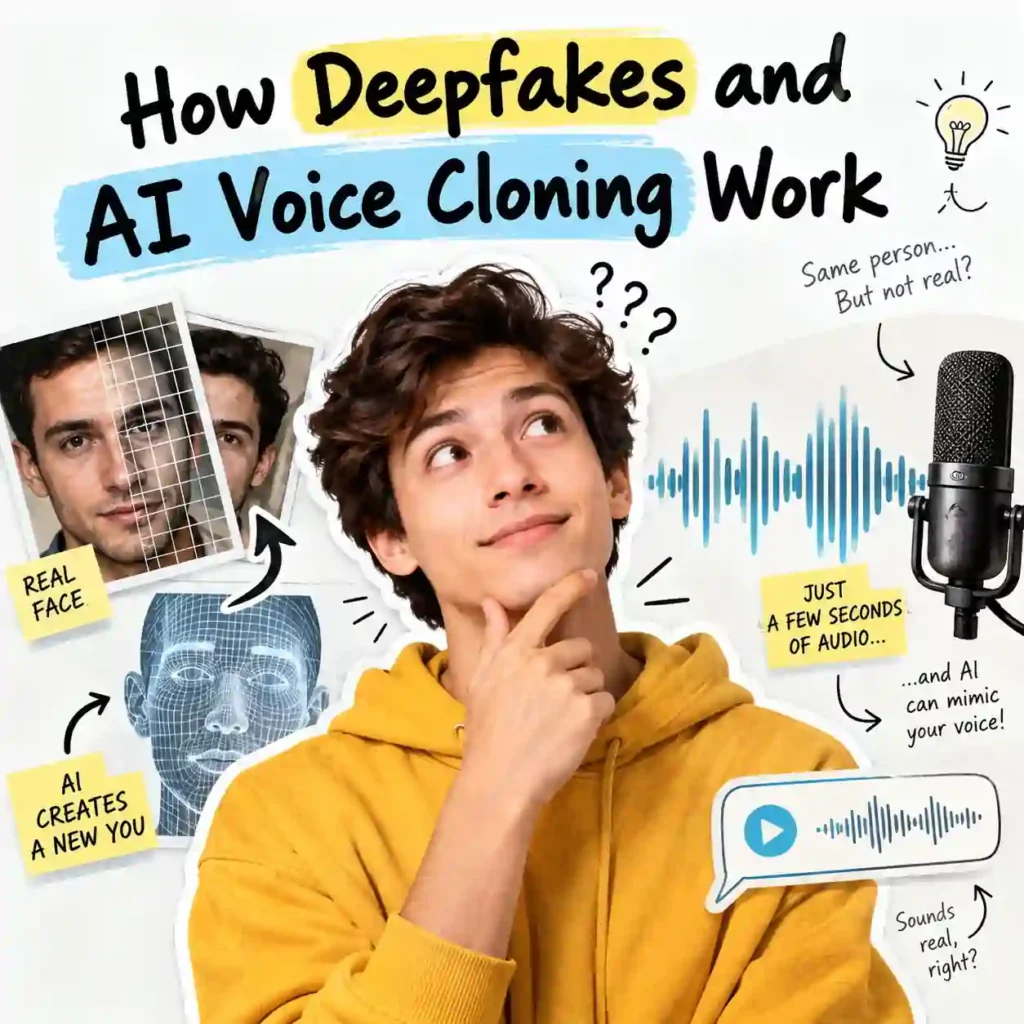
The term “deepfake” comes from the underlying technology used to create them: Deep Learning. Specifically, understanding how deepfakes work relies on a brilliant piece of computer science called a Generative Adversarial Network (GAN).
Think of a GAN as a high-stakes game of cat and mouse between two different artificial intelligence programs:
- The Generator (The Forger): This AI’s job is to study thousands of images of a target person (let’s say, a famous actor) and generate a fake image or video frame that looks exactly like them.
- The Discriminator (The Detective): This AI’s job is to look at both real images of the actor and the fake images made by the Generator, and try to guess which one is the fake.
At first, the Generator is terrible at its job. It creates a blurry, unnatural face. The Discriminator easily catches the fake. But every time it gets caught, the Generator learns why it failed. It adjusts its algorithms to make the skin texture more realistic, the lighting more natural, and the facial expressions more accurate.
This process loops millions of times. Eventually, the Generator becomes so good at creating fake images that the Discriminator (and the human eye) can no longer tell the difference.
Swapping the Face
To make a deepfake video, the AI maps the facial expressions of a “source” actor (the person actually in the video) onto the “target” person (the face being inserted). It tracks key points on the face—like the corners of the mouth, the edges of the eyes, and the jawline—and warps the target face to match those exact movements frame by frame.
The Audio Illusion: AI Voice Cloning
While deepfake videos take powerful computers to render, AI voice cloning is shockingly easy. Today, some AI models only need a 3-second audio clip to perfectly clone your voice.
How does it do this?
When you speak, your voice is entirely unique, determined by the size of your vocal cords, the shape of your throat, and how you articulate sounds. AI voice cloning software uses a neural network to analyze these unique characteristics:
- Phoneme Breakdown: The AI breaks down the audio clip into phonemes (the distinct sounds that make up words, like the “c” sound in “cat”).
- Spectrogram Analysis: It converts the audio into a spectrogram—a visual representation of the sound frequencies over time.
- Voice Synthesis: The AI learns the specific pitch, tone, cadence, and breath patterns of the target voice. When you type in a new sentence, the AI mathematically reconstructs how those phonemes should look on a spectrogram based on the target’s voice, and then converts that back into audio.
The result is a synthetic voice that can laugh, pause, breathe, and convey emotion just like the real person.
Why This Technology is Terrifying
The implications of perfect digital forgery are immense when exploring how deepfakes work in the real world.
- The Disinformation Epidemic: Deepfakes can be used to create fake videos of political leaders declaring war or admitting to crimes, destabilizing elections and financial markets before the truth can be verified.
- Cybersecurity and Scams: Voice cloning is already being used in “grandparent scams,” where scammers clone a relative’s voice using audio pulled from social media and call asking for ransom or bail money.
- The End of Truth: The psychological impact is known as the “Liar’s Dividend.” If anything can be faked, then bad actors can simply claim that real, damning video evidence of their actual crimes is just a deepfake.
How to Spot a Deepfake (For Now)
While GANs are incredibly smart, they aren’t perfect yet. If you know what to look for, you can often spot how deepfakes work and spot the flaws in the matrix:
- Unnatural Blinking: Early deepfakes struggled with blinking because training datasets mostly consisted of photos of people with their eyes open. While this is improving, blinking that looks too slow, too fast, or robotic is a red flag.
- Weird Lighting and Shadows: The AI often struggles to calculate how light should interact with the fake face compared to the rest of the environment. Look for shadows that don’t match the light source.
The Future of Digital Reality
Technology companies are currently in an arms race against deepfakes, developing advanced detection software that analyzes videos at a pixel level to find mathematical anomalies left behind by the Generator AI.
As we move further into the age of AI, learning how deepfakes work equips us for the future. The golden rule of the internet has never been more important: Don’t believe everything you see.
2 Comments