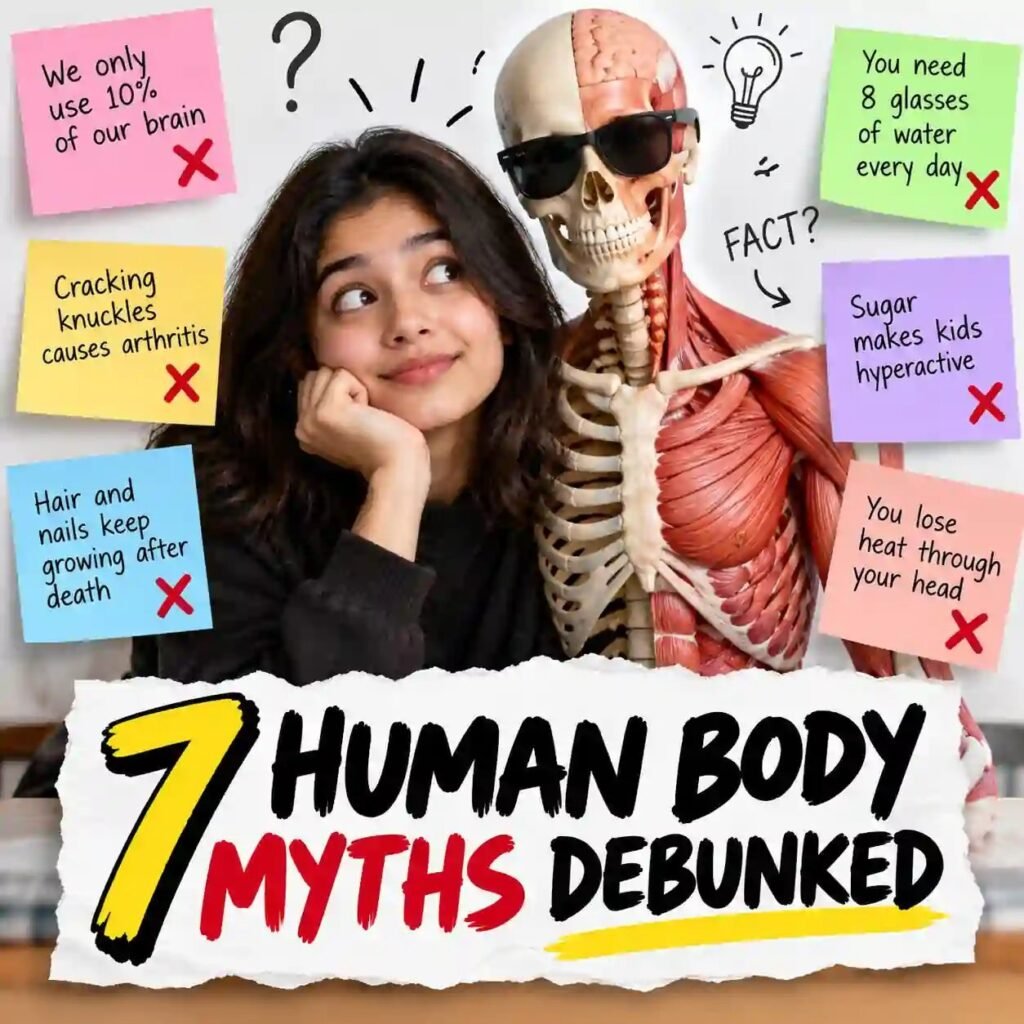
When it comes to human biology, fiction often travels faster than fact. We grow up hearing well-meaning advice from our parents, doctors, and teachers, only to pass it on to the next generation without ever questioning its scientific validity. From the dangers of knuckle cracking to the true operating capacity of the human brain, we have gathered 7 human body myths debunked to set the record straight using cold, hard, evidence-based science.
In this ultimate, highly detailed guide to 7 human body myths debunked, we break down the most popular biological misconceptions with proven scientific evidence, historical context, and expert medical research insights.
Table of Contents
7 Human Body Myths Debunked: Biological Pseudoscience vs Real Science
Myth 1: We Only Use 10% of Our Brains
When analyzing 7 human body myths debunked by modern neuroscience, the 10% brain myth is undeniably the most widespread. It has inspired countless science fiction novels and Hollywood blockbusters (such as Lucy or Limitless), suggesting that if human beings could somehow unlock the hidden 90% of their brains, they would unleash superhuman intellect, instant photographic memory, or even telepathic abilities.
The Reality: Neurologists and brain imaging experts confirm that we use virtually 100% of our brains every single day. Modern neuroimaging techniques, such as functional magnetic resonance imaging (fMRI) and positron emission tomography (PET) scans, reveal that even while we are sound asleep, our brain exhibits active neural firing across nearly every complex network. Every anatomical region of the brain has a known biological function, and even minor localized brain tissue damage from strokes or head trauma can cause severe physical, cognitive, and sensory deficits. From an evolutionary perspective, carrying around a massive 3-pound organ that used only 10% of its resources would be an absurd metabolic waste. The 10% figure is completely fabricated and holds zero scientific merit.
Myth 2: Cracking Your Knuckles Causes Arthritis
For generations, children have been sternly warned by parents and teachers that popping their knuckles will damage their joints and inevitably lead to swollen, painful hand arthritis in old age.
The Reality: The loud, satisfying popping sound you hear when pulling or bending your fingers is not bones grinding against one another or cartilage tearing. It is simply the physical phenomenon of cavitation: the rapid formation and immediate collapse of tiny gas bubbles (primarily nitrogen and carbon dioxide) within the synovial fluid that lubricates your metacarpophalangeal joint capsules.
Dr. Donald Unger famously performed an informal clinical trial on himself: he cracked the knuckles of his left hand exclusively at least twice a day for over 60 consecutive years, while leaving his right hand uncracked as a scientific control group. After six decades and over 36,000 knuckle cracks, he radiologically evaluated both hands and found absolutely no difference in joint health or osteoarthritis development between them. For his dedicated commitment to scientific inquiry, he was awarded a prestigious Ig Nobel Prize in Medicine!
Myth 3: Shaving Makes Hair Grow Back Thicker, Faster, and Darker
Many teenagers and adults hesitate to shave fine facial peach fuzz or body hair, fearing that cutting it will somehow trigger the hair roots to produce coarse, dark, thick lumberjack stubble.
The Reality: Shaving has absolutely no influence over the underlying hair follicle physiology, growth velocity, pigmentation, or shaft thickness. Natural uncut hair tapers down to a soft, thin point at the tip. When you pass a sharp razor blade over the skin surface, you shave the hair shaft straight across at its widest, rigid base near the epidermal follicle opening.
As this blunt-cut edge emerges during regrowth, the flat cross-section feels coarse and stubbly to the touch and reflects light differently, creating a convincing optical and tactile illusion of increased density and darker color.
Myth 4: Sugar Makes Kids Hyperactive
Another prominent entry among 7 human body myths debunked is the famous sugar rush phenomenon. If you have ever attended a young child’s birthday party, you have almost certainly witnessed parents attributing frantic running and shouting to a massive “sugar high” or “sugar rush” caused by cake, ice cream, and soda.
The Reality: Controlled double-blind behavioral studies published in leading medical journals like The New England Journal of Medicine have repeatedly demonstrated that refined sugar consumption does not alter children’s behavior, attention span, or hyperactivity levels. In these trials, neither parents, children, nor researchers knew which children received sugar vs artificial sweeteners, and behavioral ratings showed no difference.
The wild behavior observed at parties is actually driven by the exciting social environment, lack of routine, sensory overload, and parental confirmation bias—parents who expect sugar to cause chaos interpret normal childhood excitement as sugar-induced hyperactivity.
Myth 5: You Swallow 8 Spiders a Year in Your Sleep
This horrifying statistic has circulated across the internet and social media for decades, causing endless bedtime anxiety for arachnophobes worldwide.
The Reality: It is biologically, ecologically, and behaviorally impossible. Spiders rely heavily on airborne vibrations and tactile cues to navigate and detect immediate threats. To a spider, a sleeping human represents a terrifyingly large, noisy, vibrating, breathing entity. Spiders actively avoid large warm-blooded mammals.
Furthermore, your body maintains active cough, swallow, and touch reflexes even while sleeping; if a creeping insect stepped onto your sensitive lips or open mouth, you would instantly wake up and brush it away. This urban legend was actually intentionally invented in a 1993 magazine article specifically to illustrate how rapidly false facts and unverified stats spread across the internet!
Myth 6: Carrots Give You Night Vision
During World War II, the British Ministry of Information ran a widely publicized propaganda campaign asserting that Royal Air Force fighter pilots possessed extraordinary nocturnal vision because they consumed vast quantities of fresh carrots.
The Reality: This claim was a clever military deception created to conceal the British military’s secret breakthrough in airborne interception radar technology! While carrots are rich in beta-carotene—a precursor to Vitamin A that supports retinal rod function and prevents night blindness—eating extra carrots will not give you superhuman eyesight or allow you to see in complete pitch darkness. At most, consuming enormous quantities of carrots will harmlessly color your skin slightly orange (carotenemia).
Myth 7: You Need to Drink 8 Glasses of Water a Day
Rounding out our list of 7 human body myths debunked is daily water consumption. Millions of people haul giant water bottles around daily, worried about severe dehydration if they fall short of the famous “8×8 rule” (eight 8-ounce glasses, totaling 64 fluid ounces per day).
The Reality: The rigid 8×8 recommendation lacks scientific foundation. Your daily fluid intake requirements depend on individual body weight, climate, physical activity, and metabolic health. Furthermore, you receive approximately 20% of your daily water intake directly from moisture in solid foods like fruits and vegetables. Other beverages—including milk, tea, juice, and even coffee—also contribute effectively to overall daily hydration. The human body is equipped with a highly sophisticated thirst mechanism regulated by the kidneys; simply drinking when you feel thirsty is all most healthy adults need.
Conclusion: 7 Human Body Myths Debunked
Debunking biological myths is essential for making informed personal health decisions and avoiding unnecessary anxiety. When we rely on evidence-based science rather than popular hearsay, we protect ourselves from false health scares and bogus wellness claims. We hope these 7 human body myths debunked helped clear up long-standing misconceptions!
Did any of these scientific facts surprise you? At ScienceHubb, we are passionate about exposing pseudoscience and promoting factual discovery. If you enjoyed reading about these 7 human body myths debunked, explore our other insightful ScienceHubb guides and share this post with friends to spread real science!