Table of Contents
Stop for a second and look around the room. The glowing screen you are staring at, the coffee sitting in your mug, the air filling your lungs, and the actual blood pumping through your veins. Everything. Literally everything in the entire known universe is baked using just 118 ingredients.
That’s it. 118.
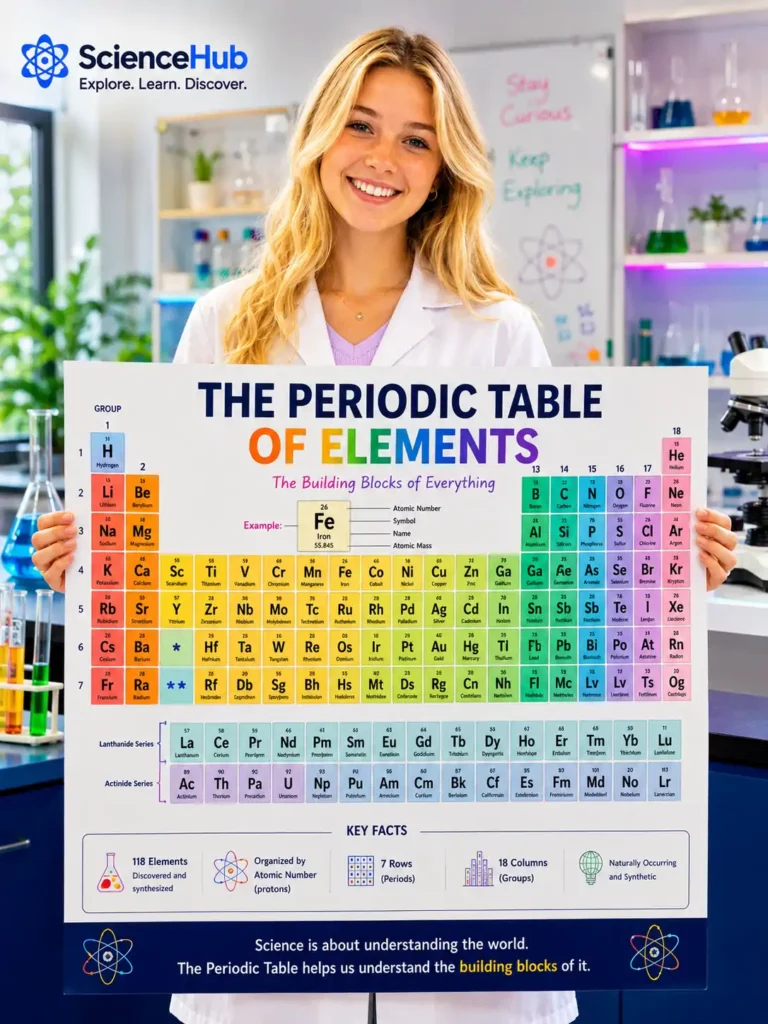
We call these ingredients elements, and scientists have them all organized on that giant poster hanging in every high school chemistry lab on the planet: the Periodic Table of Elements.
But here’s the secret. That chart isn’t just a random list of boring letters and numbers. It is a brilliant, color-coded cheat sheet for the universe. It’s a map. Let’s decode it, and uncover the insane stories behind the stuff that builds reality.
The Mad Genius Who Built It
Back in 1869, there was this wild-haired, brilliant Russian chemist named Dmitri Mendeleev. At the time, scientists only knew about 63 elements, and it was a mess. Nobody could organize them.
Mendeleev supposedly wrote the names and weights of the elements on cards and played a massive, obsessive game of chemical solitaire for three days straight. Eventually? He noticed a pattern. A repeating, “periodic” rhythm.
But here is why Mendeleev is a legend. He didn’t just organize what they had. He purposely left blank spaces on his chart. He told the world, “Hey, there’s an element missing right here. It hasn’t been discovered yet, but when you find it, it will weigh exactly this much and look exactly like this.” And years later? He was totally right.
If you want to read more mind-blowing chemistry history, the American Chemical Society (ACS) is loaded with incredible archives.
Also, if you want a ridiculously cool piece of office art, grab a High-Resolution Periodic Table Poster with real elements embedded inside. Seeing the actual flakes of gold and uranium in the acrylic is amazing.
Cracking the Code: How to Read It
It looks intimidating, but the table only really has two simple rules:
1. The Rows (The Atomic Number)
Read it like a book. Left to right, top to bottom. That big number at the top of every square? That’s the Atomic Number. It tells you exactly how many protons are jammed inside the atom.
– Hydrogen is #1 because it has exactly 1 proton.
– Carbon is #6. It has 6 protons.
And here’s the crazy part: if you manage to rip a proton out of an atom, or shove an extra one in, it literally morphs into a completely different element.
2. The Columns (The Families)
The vertical columns are basically messy family trees. Elements in the same column act exactly like siblings because they share the same number of outer electrons.
– The far-left column? Those are the Alkali Metals. They are highly reactive drama queens. If you drop a chunk of pure sodium into a bucket of water, it will violently explode.
– The far-right column? The Noble Gases. Helium, Neon. They are snobs. They are perfectly stable and absolutely refuse to react or bond with anyone else.
For a really fun deep dive, the Royal Society of Chemistry has a clickable, interactive version of the table that is incredibly addictive.
The Heroes and the Villains
Not all elements play nice. Some build us up; some want to tear us down.
– Carbon (6): The absolute rockstar of biology. If it’s alive, it’s built out of carbon.
– Uranium (92): A terrifyingly heavy, radioactive metal. It powers massive cities, but it can also level them.
– Francium (87): The most chaotic, reactive metal on Earth. It is so unstable that physicists think there is probably less than a single ounce of it existing on the entire planet at any given second.
If these weird element stories hook you, you have to read The Disappearing Spoon by Sam Kean. It is a hilarious, insane collection of true stories about madness, poison, and the periodic table.
10 Chemistry Riddles to Explode Your Mind
Can you guess the element?
1. The Riddle: I am element number one. I fuel the stars and the blazing sun. What am I?
The Answer: Hydrogen.
2. The Riddle: I make your voice incredibly high, and I’m the very reason party balloons fly. What am I?
The Answer: Helium.
3. The Riddle: I am the absolute backbone of life on Earth, from the oldest tree to a baby’s birth. What am I?
The Answer: Carbon.
4. The Riddle: You breathe me in just to survive, but rust is the prize that I derive. What am I?
The Answer: Oxygen.
5. The Riddle: I am a shiny yellow metal that drives people mad. I’ve caused wars, stolen ships, and made pirates glad. What am I?
The Answer: Gold (Au).
6. The Riddle: I’m a liquid metal, toxic and sleek. I lived inside thermometers to check if you were weak. What am I?
The Answer: Mercury.
7. The Riddle: I am the glowing gas in bright city signs, flashing red and orange in nighttime lines. What am I?
The Answer: Neon.
8. The Riddle: I’m the metal that Superman absolutely hates. (Though in real life, I don’t actually glow green.) What am I?
The Answer: Krypton.
9. The Riddle: I build up your teeth and strengthen your bones, found in cold milk and limestone stones. What am I?
The Answer: Calcium.
10. The Riddle: I am the heavy, radioactive rock used in reactors to boil the nuclear pot. What am I?
The Answer: Uranium.
The Wrap Up
The Periodic Table isn’t just a chart you memorize to pass a test. It’s the entire alphabet of the cosmos. Because scientists cracked this code, we can invent wild new medicines, build smartphones, and launch rockets.
To keep exploring the microscopic weirdness of the universe, ScienceNews and the National Science Foundation are the perfect places to waste an afternoon. Go mix some stuff together!
1 Comment