Table of Contents
The very first time you sit down in a high school biology lab, the teacher will place a massive, heavy, $400 metal machine on the desk in front of you. To use this machine, you must learn the key microscope parts and how they function.
It is covered in tiny dials, heavy glass tubes, a bright blinding light, and massive warning labels. It looks terrifying. And if you grab the wrong dial and twist it too hard, you will hear the sickening CRACK of a glass slide breaking, ruining the experiment and infuriating the teacher.
A compound microscope is a precision optical instrument. You cannot just blindly twist knobs until the image looks good. You must understand the exact anatomy of the machine. Let’s break down every single knob, glass tube, and light source, so you can operate a microscope like a professional scientist instead of a confused student.
Essential Microscope Parts: The Glass Eyepiece and Objectives
The entire point of a microscope is to bend light using glass. There are two main sets of glass you must understand.
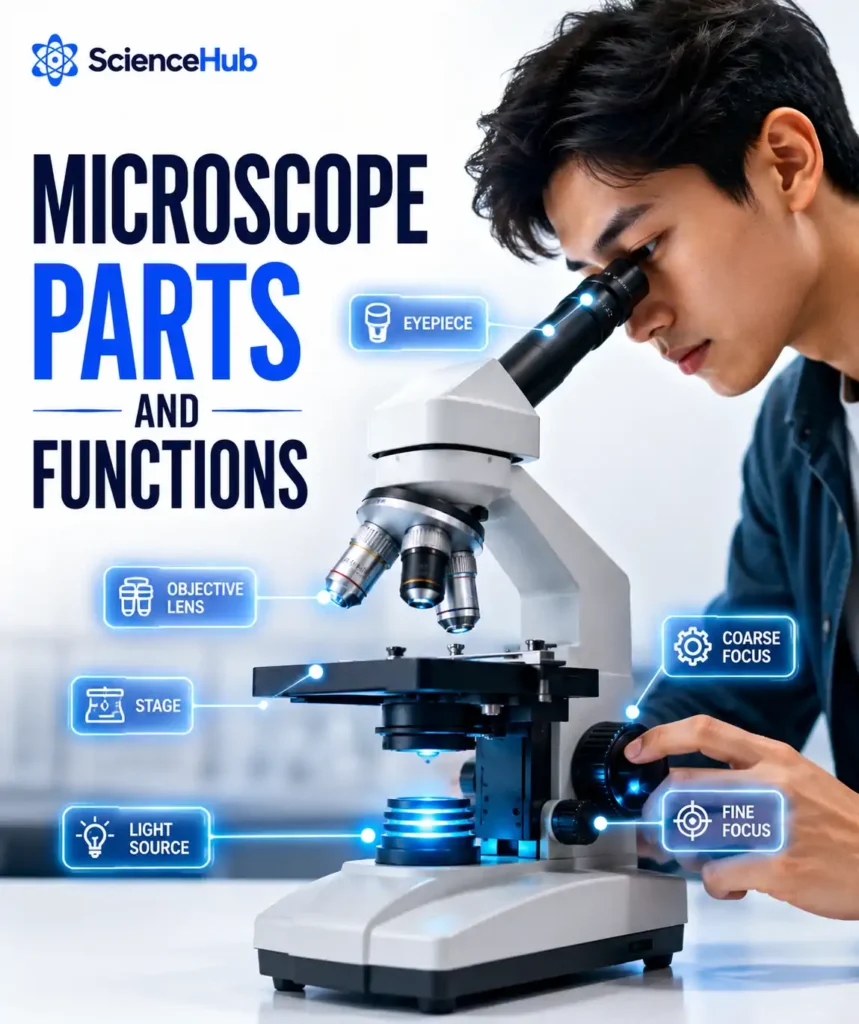
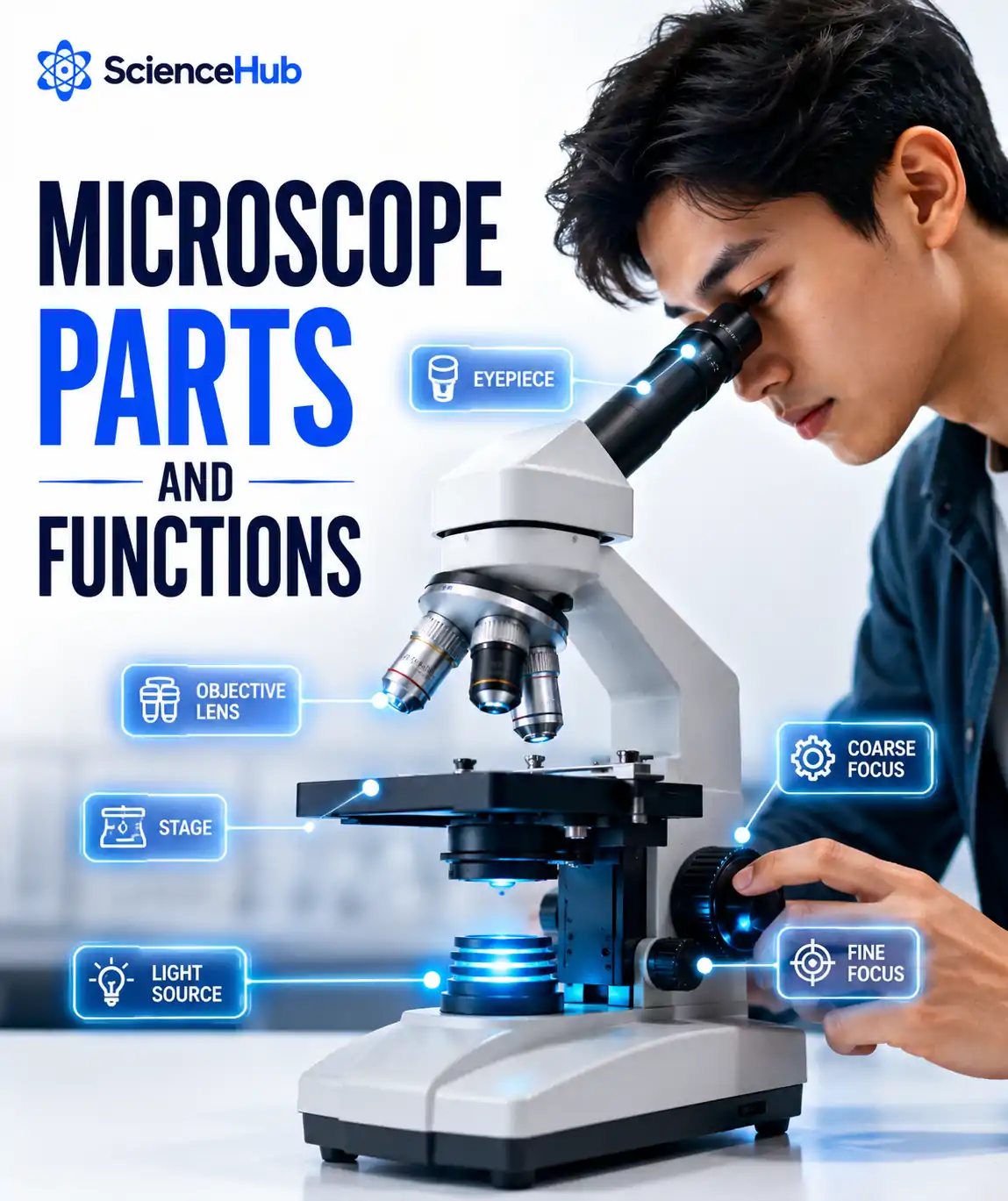
The Ocular Lens (Eyepiece): This is the tube you physically press your eye against. Most standard eyepieces have a built-in magnification of 10x. This means before the light even hits the rest of the microscope, it is already blown up ten times larger.
The Objective Lenses: These are the three or four heavy metal tubes pointing straight down at the sample. These critical microscope parts are mounted on a rotating Revolving Nosepiece. They usually come in three powers:
– 4x (Scanning)
– 10x (Low Power)
– 40x (High Power)
To calculate your Total Magnification, you multiply the eyepiece by the objective. If you look through the 10x eyepiece, and you have the 40x objective clicked into place, you are looking at the bacteria blown up 400 times (10 x 40 = 400).
If you want a brilliant, highly technical breakdown of exactly how these lenses are ground to eliminate color distortion, Nikon’s MicroscopyU is the absolute bible of optical engineering.
The Movement: Stage and Focus
Once the glass is set, you have to physically move the specimen into the perfect focal point using the appropriate mechanical microscope parts.
The Stage: This is the flat, black metal platform where you place your glass slide. It has small metal Stage Clips to lock the fragile glass in place so it doesn’t slide around when you breathe.
Coarse Focus Knob: This is one of the most important microscope parts to handle with care. When you twist it, the entire stage violently moves up and down. NEVER use the Coarse Focus knob when you are on High Power (40x). The stage will move up too fast, smash the slide into the objective lens, and shatter the glass. You only use this knob when you are on the lowest 4x power to find the target.
Fine Focus Knob: This is the tiny knob built into the side of the coarse knob. It barely moves the stage at all. Once you have the target generally in view, you slowly twist this tiny knob to make the blurry image razor-sharp.
For incredibly clear, visual diagrams of exactly how to safely focus a high-power objective, Science Buddies offers brilliant student tutorials.
The Lighting: Condenser and Diaphragm
A microscope is useless without light, which is controlled by specific optical microscope parts.
The Illuminator: This is the bright lightbulb built into the heavy metal base of the machine. It blasts photons straight up through the hole in the stage.
The Iris Diaphragm: Hidden directly under the stage is a tiny lever. This is the diaphragm. It acts exactly like the pupil of your eye. If you slide the lever, you can make the hole wider (letting in blinding light) or smaller (cutting the light down). If you are looking at a clear, almost invisible cell, you must close the diaphragm to reduce the light, which massively increases the contrast so you can actually see the cell walls.
10 Riddles on Microscope Parts and Functions
Are your answers in razor-sharp focus?
1. The Riddle: I am the glass tube you physically put your eye against, which usually has a built-in 10x magnification. What am I?
The Answer: The Ocular Lens (or Eyepiece).
2. The Riddle: I am the rotating metal wheel that holds the three different high-power lenses. What am I?
The Answer: The revolving nosepiece.
3. The Riddle: I am the heavy metal tubes pointing down at the bug, usually labeled 4x, 10x, and 40x. What am I?
The Answer: The Objective Lenses.
4. The Riddle: I am the flat, black metal platform where you rest the fragile piece of glass. What am I?
The Answer: The stage.
5. The Riddle: I am the small metal arms that physically lock the glass slide in place so it doesn’t move. What am I?
The Answer: The stage clips.
6. The Riddle: I am the massive knob you twist to rapidly move the stage up and down, but which you must never touch on high power. What am I?
The Answer: The Coarse Focus knob.
7. The Riddle: I am the tiny knob you twist to get the blurry image perfectly, razor-sharp. What am I?
The Answer: The Fine Focus knob.
8. The Riddle: I am the bright bulb hidden in the very bottom of the heavy metal base. What am I?
The Answer: The illuminator (or light source).
9. The Riddle: I am the tiny lever hidden underneath the stage that controls exactly how much light hits the sample. What am I?
The Answer: The Iris Diaphragm.
10. The Riddle: I am the sickening, terrifying sound you hear when you use the coarse focus knob incorrectly and smash the glass. What am I?
The Answer: A crack (or shatter).
The Wrap Up
A microscope is not a toy; it is a highly engineered tool. If you respect the glass, control the light with the diaphragm, and treat the coarse focus knob like a loaded weapon, you will master all the essential microscope parts and unlock the hidden cellular universe.
If you want to see the stunning, prize-winning photographs captured by professionals using these exact parts, browse the gallery at the Nikon Small World Competition. Dial in your focus, and start looking.