Table of Contents
If you are buying a microscope for the first time, you are going to hit a massive wall of confusing scientific jargon within three seconds.
The most important, absolute first decision you have to make is choosing between a Compound Microscope and a Stereo Microscope.
If you buy the wrong one, you will be incredibly frustrated. If you buy a compound microscope to look at a cool rock you found in the garden, you will see absolutely nothing but a black, blurry shadow. If you buy a stereo microscope to look at bacteria, you will just see a puddle of clear water.
These two machines do entirely different jobs. Let’s break down exactly what they do, how they bend light, and which one you actually need for your home laboratory.
The Compound Microscope: Seeing the Invisible
When you picture a scientist in a lab coat hunched over a microscope in a movie, they are using a Compound Microscope.
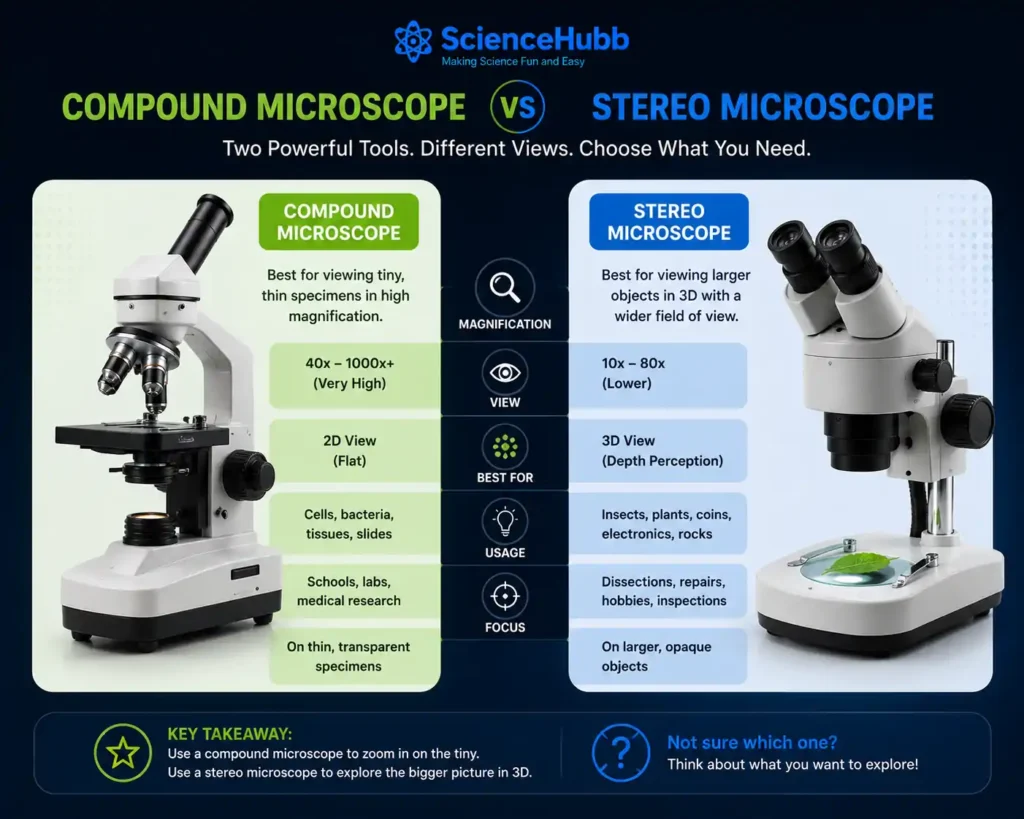
These are designed for High Magnification (usually between 40x and 1000x). They are specifically built to look at things you cannot see with the naked eye: blood cells, bacteria, and the intricate cell walls of an onion skin.
Here is the catch: A compound microscope shoots light from the bottom, directly up through the sample. That means whatever you are looking at must be transparent. You have to slice your specimen incredibly thin and trap it between two pieces of glass (a slide and a cover slip).
If you put a thick, solid object (like a coin or a bug) under a compound microscope, the light cannot shine through it. You will just see a black silhouette. For a brilliant technical breakdown of exactly how these bottom-lit condensers work, the Royal Microscopical Society offers amazing free guides.
If you want to look at cells and microbes, the AmScope B120C Compound Microscope is the undisputed king of entry-level high magnification.
The Stereo Microscope: The 3D Explorer
Also known as a “Dissecting Microscope,” a Stereo Microscope is the exact opposite of its compound cousin.
These are designed for Low Magnification (usually between 10x and 40x). Instead of shining light up through the bottom, they shine light from the top, down onto the object.
This means you do not need glass slides. You do not need to slice things thin. You can literally just take a massive, solid object—a circuit board, a diamond ring, a dead spider, or a leaf—throw it under the lens, and instantly see it in stunning, 3D detail.
It is called “stereo” because it uses two separate optical paths (one for each eye), giving you true depth perception. This is why jewelers and electronics repair technicians use them constantly. If you want to dive into the world of surface-level biology without the hassle of making slides, grab the Swift S41-20 Stereo Microscope.
For amazing galleries of what bugs look like under a stereo lens, check out the Microscopy Society of America.
The Verdict: Which One Do You Buy?
It all comes down to what you want to do.
– Do you want to look at living amoebas swimming in pond water? Buy a Compound Microscope.
– Do you want to look at the hairy legs of a dead fly or fix the motherboard on a laptop? Buy a Stereo Microscope.
10 Microscopic Logic Riddles
Can you focus your brain on these questions?
1. The Riddle: I am the type of microscope that uses massive magnification to look at tiny, transparent cells. What am I?
The Answer: A compound microscope.
2. The Riddle: I am the type of microscope that shines light from the top to look at solid, 3D objects like coins. What am I?
The Answer: A stereo microscope.
3. The Riddle: I am the tiny, flat rectangular piece of glass you must use if you are operating a compound microscope. What am I?
The Answer: A microscope slide.
4. The Riddle: I am the reason you cannot put a solid rock under a compound microscope—because the light cannot pass through me. What am I?
The Answer: Opaque (not transparent).
5. The Riddle: I am the biological building block of life, completely invisible to the naked eye, but easily seen at 400x zoom. What am I?
The Answer: A cell.
6. The Riddle: I am the tiny, fragile square of glass you drop on top of your water sample to lock it in place on the slide. What am I?
The Answer: A cover slip.
7. The Riddle: I am the specific feature of a stereo microscope that gives your brain true 3D depth perception. What am I?
The Answer: Two optical paths (Binocular vision).
8. The Riddle: I am the profession that constantly uses stereo microscopes to inspect diamonds and fix tiny watches. Who am I?
The Answer: A jeweler.
9. The Riddle: I am the bright bulb hidden at the bottom of a compound microscope that blasts photons up through the glass. What am I?
The Answer: The illuminator (or light source).
10. The Riddle: I am the process of slicing a specimen incredibly thin with a razor blade so light can pass through it. What am I?
The Answer: Sectioning.
The Wrap Up
You don’t need a massive laboratory to be a scientist. You just need the right tool for the job. Compound scopes unlock the cellular world, while stereo scopes unlock the intricate details of the physical world.
If you are obsessed with imaging, keep an eye on the latest breakthroughs published in Nature Methods. The optics are getting better every single year.
2 Comments