Table of Contents
So, imagine you’re completely lost inside a gigantic, terrifying corn maze.
If you have a normal computer helping you escape, it’s going to sprint down the first path, hit a dead end, turn around, run all the way back to the start, and try path number two. It checks every. Single. Route. One after the other. Eventually, sure, it finds the exit. But it takes forever.
Now, what if you had a computer that could clone itself and run down every single path in the entire maze at the exact same millisecond? It finds the exit instantly. Zero waiting.
Welcome to the absolute mind-bending witchcraft that is Quantum Computing.
I know it sounds like a buzzword invented for a Marvel movie, but it’s real. And it is going to completely flip our world upside down. Let’s ignore the suffocating college physics equations for a second and just talk about what this actually is.
Forget What You Know About Bits
Right now, whatever device you are reading this on operates using regular old “bits.” Everything on the internet boils down to billions of tiny switches that are either flicked to 0 or flicked to 1. Off or On. That’s it. Black and white.
But quantum computers? They use qubits (quantum bits). And because quantum physics is basically a bad trip, a qubit doesn’t have to choose. Thanks to a weird rule called superposition, a qubit can be a 0, a 1, or… both. Simultaneously.
Think of a coin. When it’s sitting on the table, it’s heads or tails. A regular bit. But when you flick it into the air, while it is spinning in a blur? It’s kind of both heads and tails at once. That’s your qubit.
If your brain is hurting right now, don’t worry. That’s normal. Grabbing a simple, highly-rated Quantum Physics for Beginners book on Amazon is honestly the best way to slowly digest this without wanting to scream.
The Weirdness Deepens: Entanglement
Oh, you thought superposition was weird? Wait until you meet entanglement.
In the quantum universe, two particles can become “tangled” together. And when they do, whatever happens to Particle A instantly happens to Particle B. It does not matter if Particle B is on the other side of the room, or sitting on the surface of Mars. The connection is instantaneous. Even Albert Einstein hated this idea. He literally called it “spooky action at a distance.”
For quantum computers, this means adding more qubits doesn’t just make the machine a little faster. It makes it exponentially, terrifyingly faster. A machine with a few hundred decent qubits could crack math problems that would take your laptop millions of years.
Are We Doing Anything Cool With It?
Well, they aren’t going to make your video games run any smoother. Quantum computers are built for the heavy, impossible stuff.
– New Drugs: They can simulate the wild behavior of molecules to invent crazy new medicines in a weekend instead of a decade.
– Security: They are going to obliterate modern passwords. Seriously, the NIST (National Institute of Standards and Technology) is currently scrambling to invent “quantum-safe” encryption before a hacker builds a quantum rig.
– Power Grids: They could map out massive, ultra-efficient energy systems to help tackle climate chaos.
So, Can I Buy One?
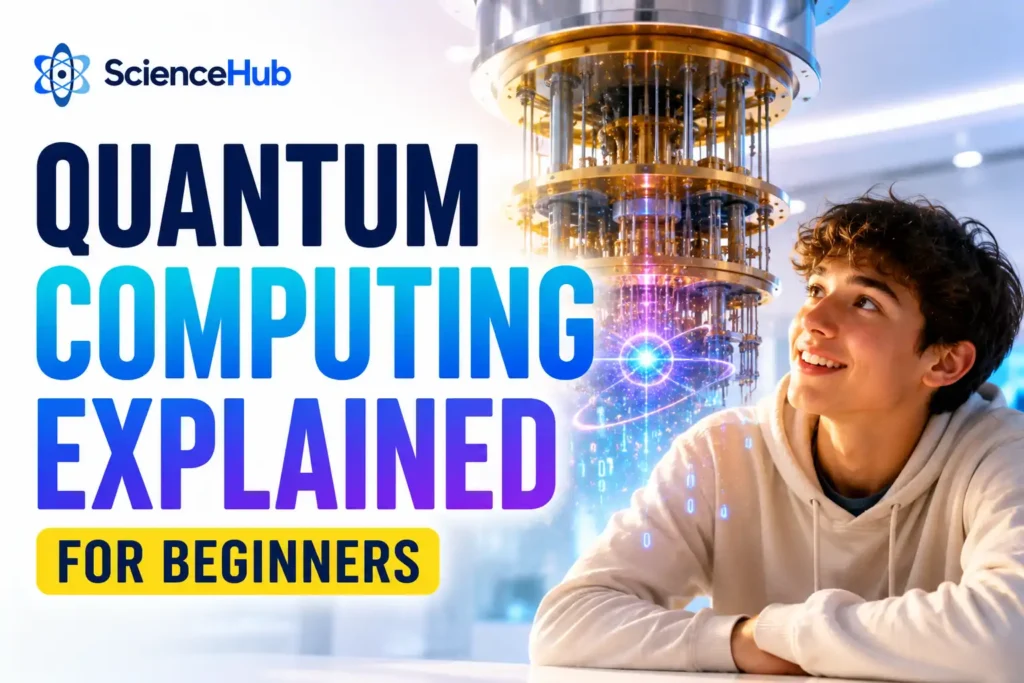
Hard no. The machines built by IBM and Google look like massive, freezing-cold gold chandeliers. Qubits are absurdly fragile. If a literal speck of dust hits one, or the temperature fluctuates by a fraction of a degree, the whole calculation crashes. It’s called decoherence, and it’s a massive headache for scientists.
Until they shrink these things down, you’re better off just grabbing a cool Quantum Computing poster or diagram to hang in your office so you look incredibly smart to your coworkers.
10 Quantum Riddles to Break Your Brain
Alright, let’s see if you grasped the weirdness.
1. The Riddle: I’m a zero, I’m a one, or maybe I’m both until the spinning is done. What am I?
The Answer: A Qubit.
2. The Riddle: I connect two things across empty space, ignoring the rules of time and place. What am I?
The Answer: Quantum Entanglement.
3. The Riddle: I’m a famous feline inside a dark box, simultaneously dead and alive until someone unlocks. Who am I?
The Answer: Schrödinger’s Cat.
4. The Riddle: I am the annoying noise that makes a qubit crash, turning a billion-dollar computer into useless trash. What am I?
The Answer: Decoherence.
5. The Riddle: I am boring, rigid, and only know ON or OFF. At quantum weirdness, I merely scoff. What am I?
The Answer: A classical bit.
6. The Riddle: I am the magical blur of a coin in the air, existing in multiple states without a care. What am I?
The Answer: Superposition.
7. The Riddle: I am the absolute coldest it can possibly get, where quantum computers perform their best set. What am I?
The Answer: Absolute Zero.
8. The Riddle: I am a tiny packet of glowing light, carrying quantum secrets through the night. What am I?
The Answer: A photon.
9. The Riddle: I am the historic moment a quantum machine beats a regular one, proving the impossible can be done. What am I?
The Answer: Quantum Supremacy.
10. The Riddle: I scramble your data to keep it secure, a lock that quantum computers might soon cure. What am I?
The Answer: Encryption.
Wrap Up
We are staring at the 1950s all over again. Back then, computers were the size of a gymnasium. Today, quantum computers are massive, loud, and prone to breaking. But give it time.
If you want to keep tabs on this wild frontier, bookmark the American Physical Society or Scientific American. Things are about to get really, really weird.
Cited Sources & Evidence
- NIST (National Institute of Standards and Technology)
- IBM
- American Physical Society
- Scientific American
good one