Table of Contents
When you hear “neural network,” you probably picture a glowing blue brain floating in a dark server room, plotting to take over the world.
The reality? It’s just a bunch of high-level math doing its best impression of human biology.
Neural networks are the absolute engine behind modern Artificial Intelligence. They are the reason your phone can recognize your face, the reason Tesla cars can see stop signs, and the reason Netflix knows you want to watch another true crime documentary at 2 AM.
But how does a cold piece of silicon actually “think” like a biological brain? Let’s strip away the sci-fi movie garbage and look at the real mechanics of Deep Learning.
Copying the Human Brain
The human brain is basically a wet, squishy supercomputer. It’s made up of about 86 billion tiny cells called neurons. These neurons are wired together in a massive, chaotic web. When you learn something new—like how to ride a bike—these neurons fire electrical signals to each other, strengthening their connections.
Computer scientists looked at this biological mess and thought, “What if we just built that out of code?”
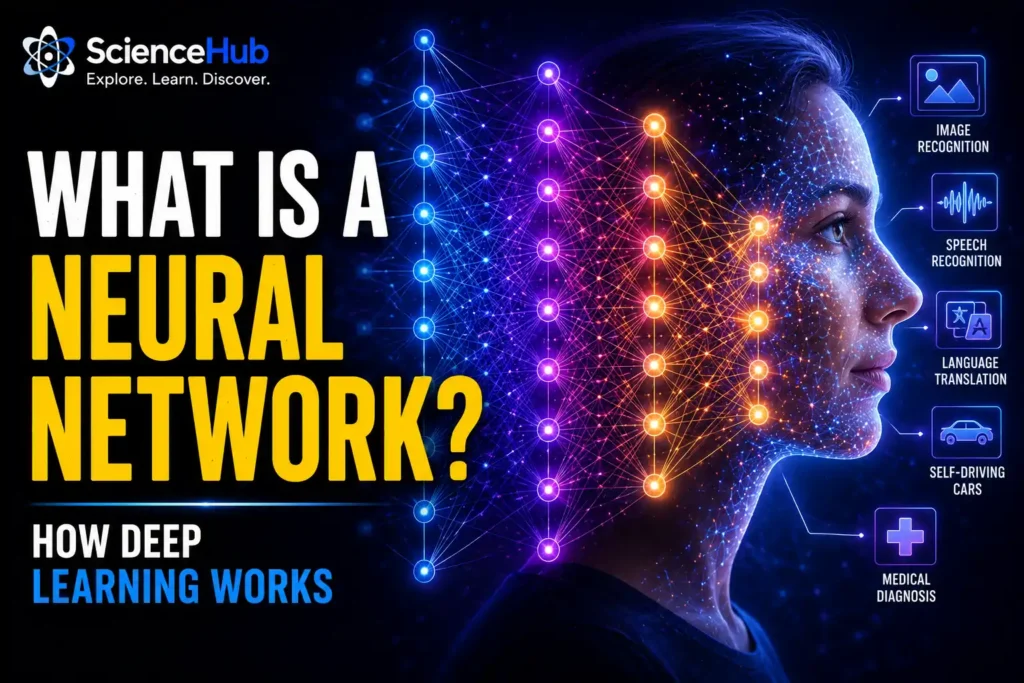
So, they created artificial neurons (called “nodes”). Instead of shooting electrical zaps, these nodes shoot numbers at each other. They arrange these nodes into distinct layers:
1. The Input Layer: This is where the data enters. Like the camera looking at a picture.
2. The Hidden Layers: This is the “deep” part of deep learning. It’s a massive sandwich of nodes crunching the numbers and looking for patterns.
3. The Output Layer: This is the final decision. “Yes, that is a stop sign.”
If you want to see exactly how these layers talk to each other without having to read a math textbook, grabbing a Machine Learning Visual Guide is a brilliant investment for your desk.
How Do They Actually Learn? (Hint: Lots of Failure)
If you build a neural network and immediately ask it to identify a cat, it will fail aggressively. It’s essentially a newborn baby. It doesn’t know anything.
To teach it, you use a process called Training. You shove one million pictures of cats into the input layer. At first, the network just guesses blindly. But every time it guesses wrong, the programmer slaps it on the wrist using an algorithm called “Backpropagation.” The math literally tells the network, “You messed up. Adjust your wiring.”
After millions of brutal, rapid-fire mistakes, the network’s internal math shifts. It starts recognizing edges. Then it recognizes fur. Then it recognizes pointy ears. Eventually, it can look at a picture of a cat it has never seen before and say, “Yep, that’s a cat.”
The absolute titans of this research are the folks at OpenAI, who have scaled this basic concept up into models with hundreds of billions of connections.
The “Deep” in Deep Learning
Why is it called “deep” learning? Because the network has dozens, sometimes hundreds, of those hidden layers stacked on top of each other.
The early layers look for simple stuff, like the straight lines in a picture. The middle layers combine those lines into shapes, like circles or squares. The deepest layers combine the shapes into a face. It’s a brilliant, layered hierarchy of understanding.
10 AI Brain-Busters
Let’s see if your biological neural network is paying attention.
1. The Riddle: I am the biological cell inside your skull that inspired all of this crazy AI code. What am I?
The Answer: A neuron.
2. The Riddle: I am the very first layer of the network, the front door where all the data walks in. What am I?
The Answer: The Input Layer.
3. The Riddle: I am the massive stack of invisible layers in the middle, doing all the heavy mathematical lifting. What am I?
The Answer: The Hidden Layers.
4. The Riddle: I am the math trick that slaps the network on the wrist when it guesses wrong, forcing it to learn. What am I?
The Answer: Backpropagation.
5. The Riddle: I am the type of learning that uses massive, deep networks of artificial neurons. What am I?
The Answer: Deep Learning.
6. The Riddle: I am the massive pile of pictures, text, and data used to teach a newborn AI. What am I?
The Answer: A Training Dataset.
7. The Riddle: I am the final layer of the network, the exit door where the AI hands you its final answer. What am I?
The Answer: The Output Layer.
8. The Riddle: I am the heavy, physical silicon chip inside your computer that crunches all this math at lightning speed. What am I?
The Answer: A GPU (Graphics Processing Unit).
9. The Riddle: I am the science of making computers mimic the human brain to solve complex problems. What am I?
The Answer: Artificial Intelligence.
10. The Riddle: I am the digital version of a brain cell, passing numbers to my neighbors instead of electricity. What am I?
The Answer: A node.
The Bottom Line
Neural networks aren’t magic, and they aren’t sentient. They are just incredibly fast, brilliantly designed math equations that learn from their own mistakes. And honestly? That is way cooler than magic.
Keep an eye on the latest breakthroughs by checking out MIT Technology Review. The models are getting deeper, smarter, and way more powerful every single day.
1 Comment