Table of Contents
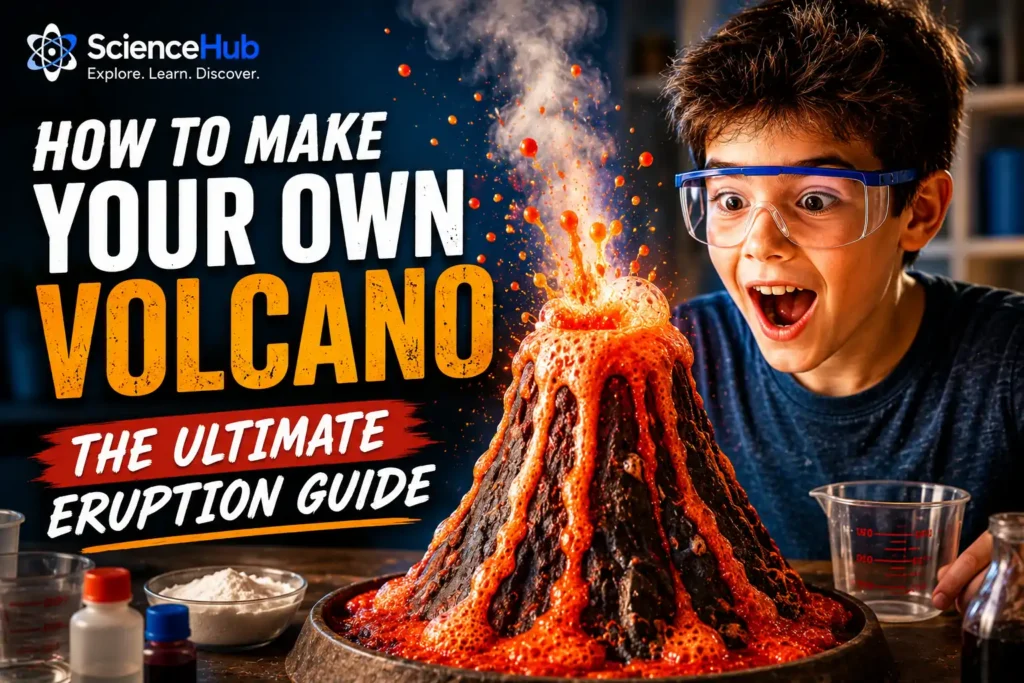
We’ve all seen it. The classic science fair project where a papier-mâché mountain explodes into a frothy, red mess all over the kitchen table. It’s iconic. It’s messy. It’s the absolute best way to introduce a kid to hardcore chemical reactions without burning down the house.
But let’s be brutally honest—most homemade volcanoes look terrible. They look like lumpy brown potatoes that slowly leak sad pink bubbles. If you’re going to build a volcano, you need to build it right. You need dramatic structural integrity, a perfectly mixed chemical payload, and an eruption that actually looks like real lava.
Forget the cheap plastic kits. This is the ultimate, step-by-step guide to engineering a high-performance, violently erupting homemade volcano from scratch.
The Mountain Structure: Papier-Mâché is King
You cannot use playdough. If you use playdough or heavy clay, the volcano will instantly dissolve into a slimy puddle of mud the second the wet “lava” hits it.
The undisputed champion of homemade mountains is Papier-Mâché. It is incredibly cheap, lightweight, and when it dries, it turns into a rock-hard, paintable shell.
Here is exactly how you do it:
1. Take an empty plastic water bottle and tape it securely to the center of a large piece of heavy cardboard.
2. Crumple up balls of newspaper and tape them tightly around the base of the bottle to create the sloped shape of the mountain.
3. Mix equal parts flour and water to create a thick, glue-like paste.
4. Dip strips of newspaper into the paste and drape them over your cardboard skeleton until the entire mountain is covered in a smooth shell.
Let it dry for 24 hours. Once it is rock solid, paint it with brown and green acrylic paint. If you don’t want to deal with the massive mess of papier-mâché, the National Geographic Earth Science Kit includes a brilliant, reusable plaster mold that builds a perfect volcano structure in ten minutes.
To read the fascinating geological history of how real stratovolcanoes physically build their own massive mountains out of cooling magma over millions of years, the U.S. Geological Survey (USGS) publishes incredible interactive maps.
The Core Payload: Baking Soda and Vinegar
The eruption itself is powered by one of the most famous chemical reactions in history: an Acid-Base Reaction.
You are going to mix an acid (white vinegar) with a base (baking soda). When these two chemicals collide, they instantly destabilize and create massive amounts of Carbon Dioxide (CO2) gas. This gas expands so violently and so rapidly that it physically blasts the liquid straight up and out of the bottle.
But you cannot just dump the powders together randomly. You need the perfect ratio.
Drop exactly 3 tablespoons of Arm & Hammer Baking Soda directly into the bottom of the empty plastic bottle inside your mountain.
For highly detailed, printable lab sheets explaining the exact molecular bonds breaking during this specific acid-base reaction, Science Buddies is the ultimate educational resource.
The Secret Ingredient: Dish Soap
If you just mix baking soda and vinegar, the eruption will be extremely fast, watery, and disappointing. It will look like a fizzy soda, not lava.
To create thick, slow-moving, bubbling magma, you must add the secret ingredient: Liquid Dish Soap.
Before the eruption, squirt a heavy amount of Dawn dish soap directly into your cup of vinegar, along with a heavy dose of red and yellow food coloring. Stir it gently.
When the chemical reaction creates the massive burst of CO2 gas, the gas gets physically trapped inside the sticky dish soap, creating millions of tiny, thick bubbles. Instead of a fast splash, the soap forces the “lava” to slowly ooze and crawl down the sides of the mountain, looking incredibly realistic.
To see exactly how fluid dynamics affect the speed of real molten lava flows based on silica content, National Geographic publishes brilliant video documentaries.
Quick Eruption Summary
Ingredients & Amounts:
- 3 Tablespoons of Baking Soda
- 1/2 Cup of White Vinegar
- 1 Heavy Squirt of Liquid Dish Soap
- A few drops of Red & Yellow Food Coloring
Step-by-Step Guide:
- Build your volcano shell using papier-mâché over an empty plastic bottle and let it dry.
- Pour the 3 tablespoons of baking soda directly into the empty bottle.
- In a separate cup, mix the vinegar, dish soap, and food coloring.
- Quickly pour the liquid mixture into the bottle and watch the lava flow!
10 Volcanic Brain Teasers
Can your brain handle the heat of these riddles?
1. The Riddle: I am the classic, messy mixture of flour, water, and newspaper used to build a rock-hard mountain shell. What am I?
The Answer: Papier-mâché.
2. The Riddle: I am the highly acidic, clear household liquid that acts as the primary fuel for the eruption. What am I?
The Answer: White vinegar.
3. The Riddle: I am the basic, white alkaline powder that violently reacts the second the acid touches me. What am I?
The Answer: Baking soda.
4. The Riddle: I am the invisible, highly pressurized gas created during the reaction that physically forces the liquid out of the bottle. What am I?
The Answer: Carbon Dioxide (CO2).
5. The Riddle: I am the specific scientific term used to describe a chemical reaction between an acid and an alkaline substance. What am I?
The Answer: An acid-base reaction.
6. The Riddle: I am the secret, thick liquid you add to the vinegar to trap the gas and create slow, oozing bubbles. What am I?
The Answer: Dish soap.
7. The Riddle: I am the liquid rock found deep underground, before it ever explodes out of the mountain. What am I?
The Answer: Magma.
8. The Riddle: I am the glowing, red-hot liquid rock that has successfully erupted out of the volcano and is flowing on the surface. What am I?
The Answer: Lava.
9. The Riddle: I am the specific type of tall, conical, highly explosive mountain, just like the one you are building. What am I?
The Answer: A stratovolcano.
10. The Riddle: I am the massive, highly respected American government agency that actively tracks and monitors real volcanic eruptions. What am I?
The Answer: The USGS (U.S. Geological Survey).
The Wrap Up
You don’t need a massive budget to do incredible science. A plastic bottle, some old newspaper, and basic kitchen ingredients are all it takes to simulate one of the most violent, terrifying natural disasters on Earth.
If you want to read terrifying historical accounts of what happens when these pressure-cooker mountains actually explode in real life (like Pompeii), bookmark the archives at the Smithsonian Institution. Build the mountain, mix the fuel, and stand back.