Table of Contents
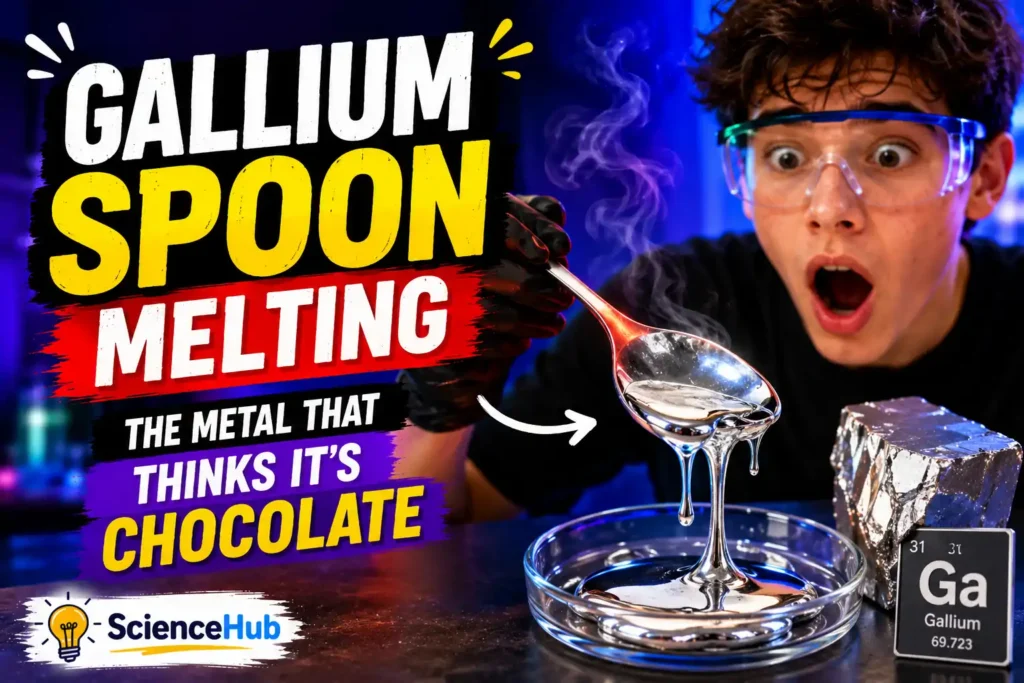
Okay, picture this. You are sitting at a fancy dinner table. You hand your friend a totally normal-looking silver spoon and tell them to stir their hot cup of tea. They put the spoon in the tea, stir it once, pull it back out, and… half the spoon is completely gone. It just vanished into the liquid. The melting gallium spoon is a classic physics-of-chaos/” style=”color: #E67E22; text-decoration: none; border-bottom: 2px solid #E67E22; font-weight: bold;”>physics trick.
They freak out. You laugh. You have just pulled off one of the greatest, most mind-science-books-every-science-student-must-read-with-links/” style=”color: #E67E22; text-decoration: none; border-bottom: 2px solid #E67E22; font-weight: bold;”>blowing-science-experiments-teenagers-can-do-for-fun-learning/” style=”color: #E67E22; text-decoration: none; border-bottom: 2px solid #E67E22; font-weight: bold;”>blowing science pranks in the world using a bizarre, real-life metal called Gallium.
No, the tea isn’t filled with acid. No, it isn’t a magic trick with hidden strings. It is hardcore physics and chemistry wrapped into one awesome little metal bar. Let me explain exactly why this metal acts like a chocolate bar left out in the sun.
What in the World is Gallium?: Gallium Spoon
When you think of metal, you probably think of tough stuff. Iron, steel, titanium. If you want to melt a steel spoon, you have to throw it into a roaring factory furnace that is thousands of degrees hot.
But not all metals are tough guys.
Gallium is a super weird element on the periodic table. It looks exactly like shiny aluminum or silver. But its secret superpower is its melting point.
The melting point is the exact temperature where a solid object turns into a liquid puddle. Think about ice. Ice is solid water. If the temperature gets above 32°F (0°C), the ice instantly starts melting into a puddle.
For steel, the melting point is around 2,500°F!
But Gallium? Gallium’s melting point is an insanely low 85.6°F (29.8°C).
Do you know what is hotter than 85.6 degrees? You are. Human body temperature is 98.6°F. This means if you just hold a solid chunk of Gallium tightly in your bare hand, your own body heat will melt it into a liquid puddle of silver metal right in your palm!
If you want to read all the hardcore, super-detailed stats on every element on the periodic table, you definitely need to check out the Royal Society of Chemistry.
The Spoon Prank Explained
So, how do we make the disappearing spoon?
You can actually buy liquid Gallium online. It usually comes in a little plastic syringe. If it’s solid, you just run it under warm water to melt it.
You can buy a special Silicone Spoon Mold online. You squirt the liquid silver Gallium into the rubber mold, and then put it in the fridge. Because the fridge is cold (way below 85 degrees), the Gallium turns into a solid, rock-hard metal spoon. It looks perfectly real. It clinks like metal. It feels heavy like metal.
But a cup of hot tea is around 160°F. When you put the Gallium spoon into the hot tea, it immediately gets blasted with heat that is way past its melting point. In seconds, the bottom half of the spoon completely melts into heavy liquid metal and sinks to the bottom of the mug.
It is completely harmless (though you absolutely should not drink the tea with liquid metal in it!). If you pour the tea out, you’ll find a puddle of silver metal at the bottom of the cup, which will turn solid again once it cools down.
To learn more about how different metals conduct heat and change states, the American Physical Society (APS) has some incredible resources for students.
Why Does It Melt So Easy?
Why is Gallium so wimpy compared to steel? It all comes down to how the tiny atoms inside it hold hands.
Imagine a group of kids playing red rover, locking their arms together super tightly. That’s steel. It takes a ton of force (or heat) to break them apart.
Now imagine those kids are barely touching fingertips. That’s Gallium. The bonds between Gallium atoms are super weak. It barely takes any heat energy at all to make them let go of each other and slide around like a liquid.
Gallium isn’t just for pranks, though. Because it’s so weird, tech companies actually use it to make microchips and LED lights! You can read all about how weird materials are used in modern technology at the National Science Foundation (NSF).
Quick Melting Spoon Summary
What you need:
– 20-50 grams of 99.9% Pure Gallium (You can get it online)
– A silicone mold shaped like a spoon
– A cup of hot water or tea
Step-by-step guide:
1. If your Gallium is solid inside its container, run the container under hot tap water for 10 minutes until it turns into a liquid.
2. Carefully squeeze or pour the liquid Gallium into the silicone spoon mold.
3. Put the mold into the refrigerator for about 30 minutes to let the metal freeze into a solid.
4. Pop the shiny metal spoon out of the mold. Don’t hold it in your bare hands for too long, or your body heat will melt the handle!
5. Stir a hot cup of tea with the spoon and watch the bottom instantly vanish into liquid metal.
10 Metal Brain Teasers
Test your brain! Can you solve these riddles about our favorite melting metal?
1. The Riddle: I look like solid silver, but if you hold me in your warm hand, I will turn into a shiny puddle. What am I?
The Answer: Gallium.
2. The Riddle: I am the exact temperature where a hard, solid object turns into a liquid. What am I?
The Answer: The melting point.
3. The Riddle: I am the normal, average temperature of a human body, which is easily hot enough to melt Gallium. What number am I?
The Answer: 98.6°F.
4. The Riddle: I am the tiny, invisible building blocks that make up a metal, and my “handshake” determines how strong it is. What am I?
The Answer: Atoms.
5. The Riddle: I am the flexible, rubbery tray you use to shape the liquid metal into a fake eating utensil. What am I?
The Answer: A silicone mold.
6. The Riddle: I am the incredibly tough, strong metal that takes thousands of degrees of fire to melt. What am I?
The Answer: Steel (or iron).
7. The Riddle: I am the hot, comforting drink you offer your friend to secretly destroy their fake spoon. What am I?
The Answer: Hot tea (or coffee).
8. The Riddle: I am the cold appliance in your kitchen where you hide the mold so the metal turns rock hard. What am I?
The Answer: The refrigerator.
9. The Riddle: I am the massive chart in science class that lists every single element in the universe. What am I?
The Answer: The Periodic Table.
10. The Riddle: I am the state of matter that Gallium turns into when it gets warmer than 85.6 degrees. What am I?
The Answer: A liquid.
The Wrap Up
Gallium is basically a glitch in the matrix. It breaks all the rules of what we think a metal should act like. It proves that just because something looks tough and strong, doesn’t mean it actually is.
If you want to start building your own collection of weird, raw elements from the periodic table, you can grab an awesome Acrylic Periodic Table with Real Elements inside to show off to your friends. Science isn’t always boring math equations; sometimes, it’s just tricking your friends into drinking liquid metal! (Seriously, don’t drink it.) The melting gallium spoon is a classic physics trick.