Table of Contents
Have you ever poured milk into your coffee and watched it swirl around in chaotic, random clouds? That is how liquid is supposed to act. It mixes randomly and stays messy.
But what if I told you there is a liquid that literally organizes itself?
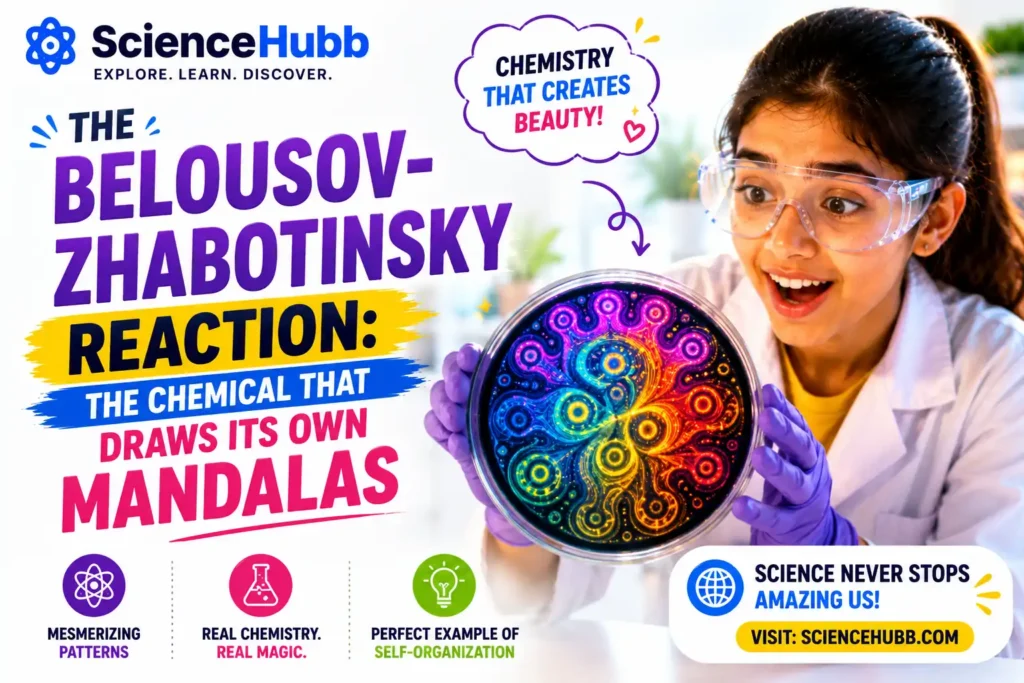
Imagine pouring a completely flat, shallow puddle of red liquid onto a glass plate. At first, it just looks like red water. But suddenly, a tiny blue dot appears in the center. Then, the blue dot expands into a perfect blue circle. Then a red circle forms inside the blue circle. Then another blue circle.
Without you touching it, the liquid automatically draws perfect, mesmerizing, pulsing circular targets—like a giant bullseye—over and over again. The circles push outward like ripples in a pond, creating the most beautiful geometric patterns you have ever seen.
This isn’t a computer simulation. It is the Belousov-Zhabotinsky (B-Z) Reaction, and it absolutely broke the brains of the scientists who first discovered it. Let me explain how a liquid can mathematically draw its own art.
Breaking the Rules of Chaos
To understand why the B-Z reaction is so famous, you have to understand a basic law of physics called Entropy.
Entropy is a fancy word that just means “everything in the universe gets messier over time.” If you drop a glass, it shatters into a messy pile. It never accidentally falls and glues itself perfectly back together. The universe naturally hates being organized.
So, when a Russian scientist named Boris Belousov mixed a bunch of messy chemicals in a beaker in the 1950s, he expected them to turn into a random, messy blob.
Instead, the chemicals started fighting each other. They formed perfect red and blue stripes that pulsed back and forth like a beating heart.
The liquid was literally breaking the law of Entropy. It was taking a messy pile of chemicals and automatically organizing them into perfect geometric patterns. Belousov’s scientific peers literally didn’t believe him. They thought he was faking it because the math seemed totally impossible!
To read more about the insane laws of Entropy and chaos theory, the American Physical Society (APS) has some incredible, easy-to-read guides.
The Chemical Pacemaker
So, how does the liquid actually draw the circles?
This is basically a much slower, much prettier version of the “oscillating” reactions we talked about before. It is a chemical seesaw.
The liquid has two states: Red (resting) and Blue (excited).
When you pour the liquid onto a flat plate, almost the entire puddle is resting (red). But in one tiny, microscopic spot, the chemicals accidentally bump into each other and trigger the “excited” state (blue).
That tiny blue dot acts like a chemical pacemaker. It forces the red liquid touching it to also turn blue. That blue liquid forces the red liquid next to it to turn blue. The blue color travels outward in a perfect ring, exactly like dropping a rock into a completely still pond.
But once the chemicals turn blue, they get exhausted. They have to “rest” and turn red again. So the middle of the circle turns red. Then it wakes up again, turns blue, and sends out another ring!
The liquid will literally spend hours drawing massive, pulsing targets until the chemicals completely run out of energy. You can read all about how these amazing self-organizing chemical waves work over at the National Science Foundation (NSF).
Why Does This Even Matter?
This experiment looks like a really cool magic trick, but it is actually one of the most important discoveries in modern biology.
Why? Because your actual heart beats using the exact same pulsing chemical math!
Your brain sends a chemical signal to a tiny spot in your heart (your biological pacemaker). That spot sends a chemical wave rippling through your heart muscles, forcing them to squeeze. The chemical “resets,” and it sends another wave. Boom-boom. Boom-boom.
Scientists use the B-Z reaction to physically study how your heart beats and how brain waves travel through your head!
Because making the B-Z liquid requires super precise measurements of some advanced lab chemicals (like Potassium Bromate and Malonic Acid), you absolutely need a professional glass Chemistry Petri Dish to watch it spread out flat. And since you are working with acids, you always need your trusty Disposable Nitrile Gloves.
If you want to read more about how chemical reactions mimic the human heart, bookmark the amazing medical archives at the National Institutes of Health (NIH).
Quick B-Z Reaction Summary
What you need:
– A B-Z chemical kit (usually containing Sulfuric Acid, Potassium Bromate, and Malonic Acid)
– A specialized color-changing dye (like Ferroin)
– A flat, clean glass petri dish
– A dropper
Step-by-step guide:
1. Put on your gloves and safety goggles.
2. Follow your kit instructions to carefully mix your clear chemical solutions in a beaker.
3. Add a few drops of the Ferroin dye to the beaker. The liquid will turn red.
4. Use your dropper to carefully squirt a very thin, flat puddle of the red liquid into your glass petri dish.
5. Sit back and watch! Tiny blue dots will magically appear and slowly expand outward into massive, perfect geometric circles!
10 Self-Organizing Brain Teasers
Is your brain pulsing with new info? Try to solve these 10 circular riddles!
1. The Riddle: I am the fancy physics word that means the universe naturally wants to be messy and chaotic, not organized. What am I?
The Answer: Entropy.
2. The Riddle: I am the famous Russian scientist who first accidentally discovered this crazy self-organizing liquid. Who am I?
The Answer: Boris Belousov.
3. The Riddle: I am the resting, exhausted color of the liquid before it gets excited. What color am I?
The Answer: Red.
4. The Riddle: I am the excited color of the liquid that spreads outward like a ripple in a pond. What color am I?
The Answer: Blue.
5. The Riddle: I am the perfect geometric shape that the liquid automatically draws as the waves push outward. What shape am I?
The Answer: A circle.
6. The Riddle: I am the human organ in your chest that actually uses these exact same pulsing chemical waves to pump blood. What am I?
The Answer: The heart.
7. The Riddle: I am the flat, round, shallow glass plate that scientists use to watch the liquid spread out perfectly. What am I?
The Answer: A petri dish.
8. The Riddle: I am the tiny glass tool with a rubber bulb that you use to squeeze the liquid onto the plate. What am I?
The Answer: A dropper (or pipette).
9. The Riddle: I am the special chemical ink added to the liquid so your eyes can actually see the red and blue colors change. What am I?
The Answer: Dye (Ferroin).
10. The Riddle: I am the massive government health agency that studies how these crazy chemical waves mimic human brain activity. What am I?
The Answer: The NIH.
The Wrap Up
The Belousov-Zhabotinsky reaction is proof that there is still so much magic hidden in the math of the universe. It proves that messy, random chemicals can actually organize themselves, draw perfect art, and mimic the beating of a human heart.
If you want to read more mind-blowing stories about how scientists discovered the hidden geometric rules of the universe, you definitely need to check out the archives at the Royal Society of Chemistry. Science isn’t always messy; sometimes, it paints a masterpiece!
Cited Sources & Evidence
- American Physical Society (APS)
- National Science Foundation (NSF)
- National Institutes of Health (NIH)
- Royal Society of Chemistry