Table of Contents
Okay, think about blowing a normal soap bubble. You dip a plastic wand into soapy water, blow into it, and a perfectly clear, invisible bubble floats away until it pops. It’s fun, but it’s pretty standard.
Now, imagine taking a giant glass bowl, filling it with warm water, and dropping a solid, freezing-cold rock into it. The water instantly starts boiling, and a massive cloud of thick, white, creepy fog pours over the sides of the bowl like a spooky graveyard on Halloween.
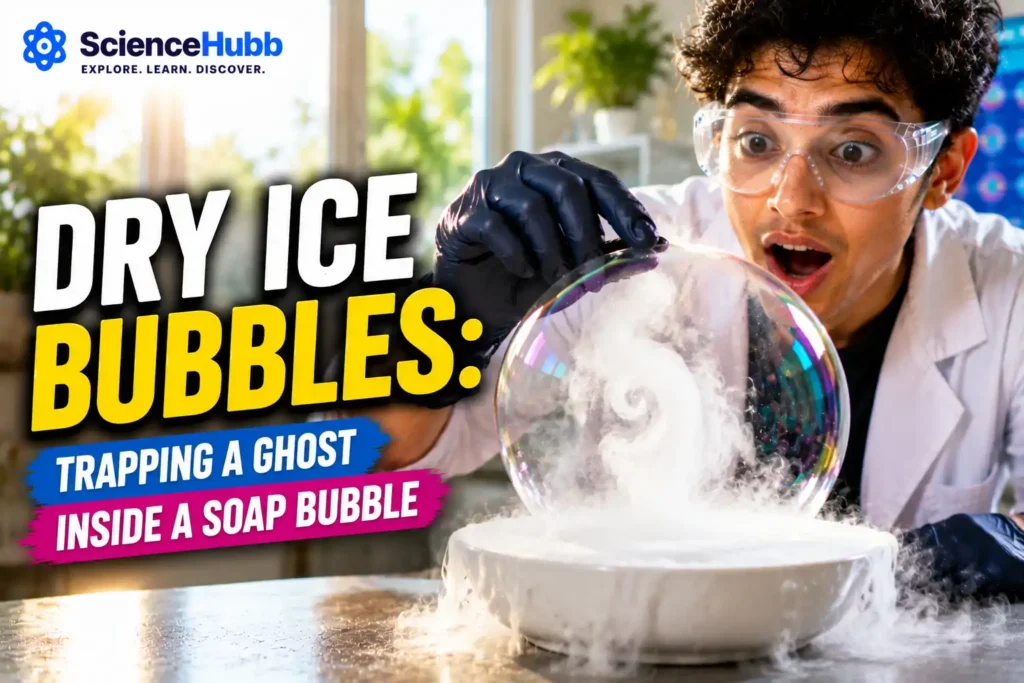
Then, you take a soapy cloth and wipe it across the top of the bowl. Instead of the fog pouring out, it gets trapped. A single, absolutely massive, thick white bubble starts growing over the entire bowl. It gets bigger and bigger, looking like a giant crystal ball filled with swirling ghosts. When you finally poke it, the bubble violently bursts, and a waterfall of heavy white fog spills completely over the table.
This is the Dry Ice Bubble trick. It is easily one of the coolest visual experiments you can do, and it all comes down to a crazy physics trick called Sublimation. Let me break it down.
The Ice That Doesn’t Melt
To understand where the fog comes from, we have to look at the rock you dropped into the water. It isn’t a normal ice cube. It is Dry Ice.
Normal ice is just frozen water. If you put it on a table, it warms up, melts into a puddle of liquid water, and eventually evaporates.
But Dry Ice is totally different. Dry Ice is frozen Carbon Dioxide (CO2) gas. And it is ridiculously cold—about -109°F (-78°C).
Because it is made of CO2, Dry Ice physically cannot melt into a liquid. It skips the liquid phase entirely. When it warms up, it violently turns straight from a solid rock directly into a gas. This crazy phase jump is called Sublimation.
If you want to read the hardcore physics of how atoms skip phases, the American Chemical Society (ACS) has some amazing articles on thermodynamics.
The Ghostly Fog
When you drop the freezing Dry Ice into warm water, you put the sublimation process into hyper-drive. The warm water violently cooks the Dry Ice, causing it to blast out massive amounts of freezing cold CO2 gas.
As the freezing CO2 gas hits the warm, humid air above the bowl, it instantly freezes the tiny water droplets in the air, creating a thick, heavy, white fog. Because CO2 gas is much heavier than normal air, the fog doesn’t float up into the sky; it pours heavily downward over the table like a liquid waterfall.
You can read more about how density affects gases over at the Institute of Physics (IOP).
Trapping the Cloud
So, we have a massive cloud of heavy fog. How do we trap it?
You take a long strip of cloth, soak it in dish soap, and carefully drag it across the rim of the glass bowl. This creates a flat roof of soap over the bowl.
The Dry Ice at the bottom of the bowl doesn’t stop sublimating. It keeps pumping out heavy white gas. Since the gas can’t escape, it pushes up against the soapy roof, stretching the soap film higher and higher into the air.
The soapy film acts like a flexible balloon, perfectly trapping the heavy white fog inside a massive, growing dome. It looks exactly like a glowing, swirling crystal ball until the soap stretches too thin and violently pops!
Because Dry Ice is so unbelievably cold, it will give you instant frostbite if you touch it with your bare hands. You absolutely must handle it using heavy-duty Insulated Leather Work Gloves. And you definitely want to use a large, smooth, clear Heavy Glass Mixing Bowl so the soapy film has a perfect edge to slide across!
To read the official safety warnings about handling cryogenic gases, check out the Occupational Safety and Health Administration (OSHA).
Quick Dry Ice Bubble Summary
What you need:
– A large chunk of Dry Ice (usually sold at local grocery stores)
– A large, smooth-rimmed glass bowl
– Warm water
– Liquid dish soap
– A long strip of cloth (like a cut-up t-shirt)
– Heavy insulated gloves
Step-by-step guide:
1. Put on your heavy insulated gloves. Never touch Dry Ice with your bare hands!
2. Fill the glass bowl halfway with warm tap water.
3. Drop the chunk of Dry Ice into the water. It will instantly start bubbling and pumping out white fog.
4. Soak your cloth strip in a mixture of water and dish soap.
5. Stretch the soapy cloth tight, and slowly drag it across the top rim of the bowl to create a flat soap film.
6. Watch the heavy fog push the soap up into a massive, swirling white dome until it pops!
10 Foggy Brain Teasers
Is your brain feeling a little cloudy? Try to solve these 10 heavy riddles!
1. The Riddle: I am the fancy science term for a solid that turns directly into a gas without ever melting into a liquid. What am I?
The Answer: Sublimation.
2. The Riddle: I am the freezing cold, solid rock of carbon dioxide used to make the heavy white fog. What am I?
The Answer: Dry Ice.
3. The Riddle: Because I am much heavier than normal air, my fog doesn’t float upward; it does this instead. What do I do?
The Answer: It sinks (or falls downward).
4. The Riddle: I am the everyday kitchen liquid used to create the flexible, stretchy roof over the bowl. What am I?
The Answer: Dish soap.
5. The Riddle: I am the exact temperature (in Fahrenheit) of a block of Dry Ice. What number am I?
The Answer: -109°F.
6. The Riddle: I am the piece of clothing material you soak in the soapy water and drag across the top of the bowl. What am I?
The Answer: A cloth (or t-shirt strip).
7. The Riddle: I am the physical injury you will get instantly if you are silly enough to touch the dry ice with your bare hands. What am I?
The Answer: Frostbite (or a cold burn).
8. The Riddle: I am the specific type of thick, protective gear you must wear on your hands to safely handle the ice block. What am I?
The Answer: Leather gloves.
9. The Riddle: What temperature of water should you use in the bowl to make the dry ice sublimate extremely fast?
The Answer: Warm water.
10. The Riddle: I am the magical-looking object you create when the heavy fog stretches the soapy film into the air. What am I?
The Answer: A bubble (or crystal ball).
The Wrap Up
Dry Ice Bubbles are the absolute best way to see the crazy physics of sublimation happen in real time. You get to watch a freezing solid rock violently cook into a heavy gas, and then you get to trap that gas inside a giant, stretchy, soapy balloon.
It is the perfect mix of physics, chemistry, and spooky Halloween magic. If you want to read more about how scientists use heavy gases and sublimation in the real world, definitely bookmark the National Science Foundation (NSF). Now grab some gloves and go trap some ghosts!
Cited Sources & Evidence
- American Chemical Society (ACS)
- Institute of Physics (IOP)
- Occupational Safety and Health Administration (OSHA)
- National Science Foundation (NSF)