Table of Contents
The universe is getting bigger every single second, and it is happening so fast it will literally make your head spin. But here is the crazy part: space isn’t expanding into anything. It isn’t a bubble getting bigger inside an empty room.
Space itself is physically stretching. Every single galaxy is rushing away from every other galaxy, like raisins trapped inside a massive loaf of bread that is baking in the oven.
When astronomers first realized this, it completely destroyed everything we thought we knew about the cosmos. If everything is flying apart right now, that means if you hit “rewind” on the universe, everything must have started from a single, infinitely tiny point. That realization is exactly how we discovered the Big Bang!
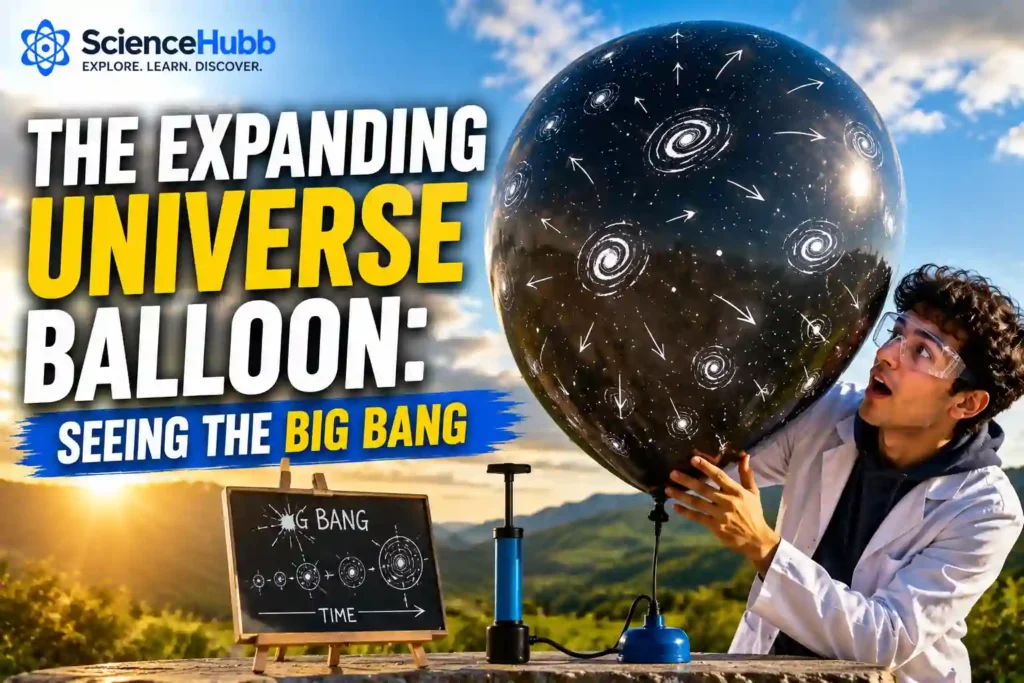
You don’t need the Hubble Space Telescope to watch galaxies fly apart. You can prove the universe is expanding right now using nothing but a cheap rubber balloon and a permanent marker. Let’s blow up the universe!
The Illusion of the Center
The hardest part about understanding the expanding universe is the illusion of a “center.”
If you stand in a room and throw a handful of bouncy balls, they all fly away from you. You feel like the center of the explosion. But in the universe, there is no center.
Imagine you are standing on a tiny galaxy in deep space. If you look through a telescope, you will see every other galaxy rushing away from you. You would naturally think, “Wow, I am the exact center of the universe!” But if you magically teleported to an alien galaxy a billion light-years away and looked through a telescope, you would see the exact same thing—everything rushing away from that spot too!
Because the very fabric of space is stretching, every single point in the universe looks like it is the center. To read the hardcore astrophysics of how scientists measure this insane stretching, you have to check out the National Aeronautics and Space Administration (NASA).
Why the Balloon Trick is Genius
The DIY Expanding Balloon trick is the absolute best way to visualize this mind-bending physics because a balloon perfectly mimics the fabric of spacetime.
When you draw dots on a deflated balloon, those dots represent entire galaxies. As you blow air into the balloon, the rubber stretches. The dots themselves don’t grow, but the empty space between the dots gets wider and wider.
If you pick one specific dot and watch it while you blow up the balloon, you will notice that every other dot is moving away from it. And the dots that are furthest away seem to move the fastest! This is a real physical law called Hubble’s Law, and it is exactly how scientists know the universe is accelerating into the freezing darkness.
To dive deeper into how astronomers use giant lasers to measure this expansion speed, take a look at the data from the European Space Agency (ESA).
Quick Summary: The Expanding Universe
What you need:
– One large, round rubber balloon (light colors work best).
– A dark permanent marker (like a Sharpie).
– A flexible measuring tape (optional, to measure the exact stretching).
Step-by-step Instructions:
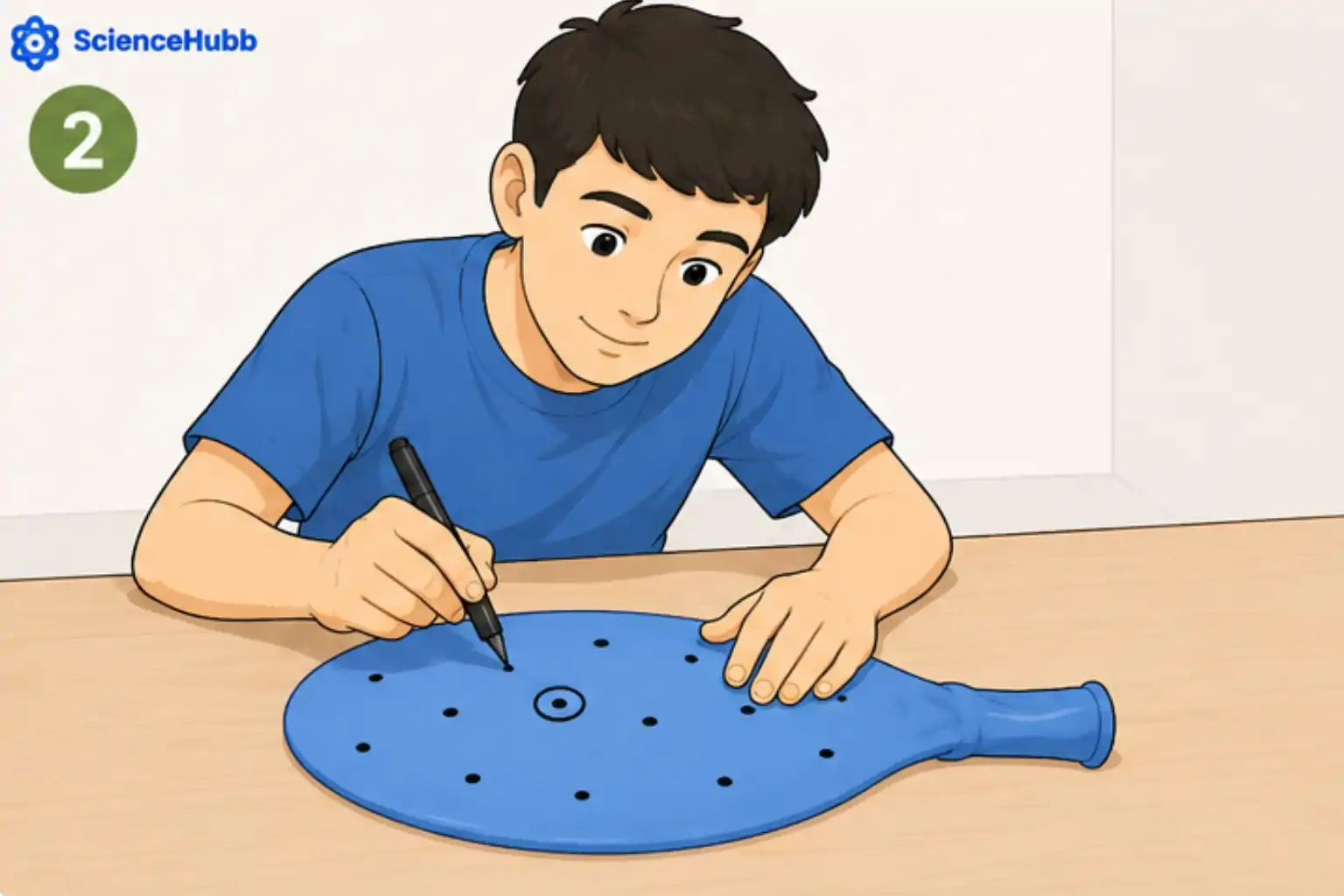
1. Lay the completely deflated balloon flat on a table and use your permanent marker to draw 10 to 15 solid dots all over it.

-
Pick one specific dot near the center to be your “Home Galaxy” and draw a small circle around it so you don’t lose it.
-
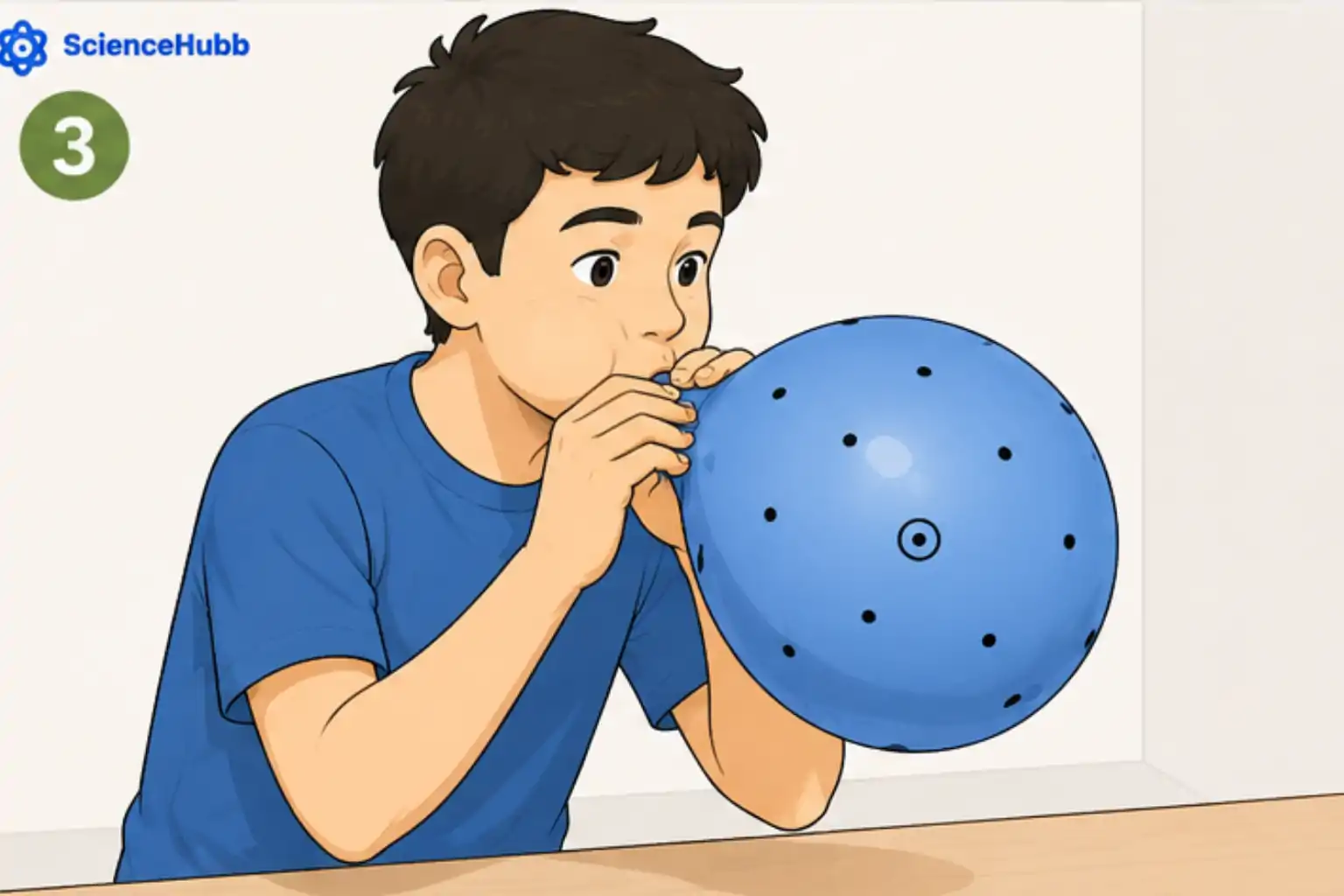
Take a deep breath and blow the balloon up just halfway. Pinch the neck closed, but do not tie it. Look closely at how the distance between your Home Galaxy and the other dots has stretched!
-
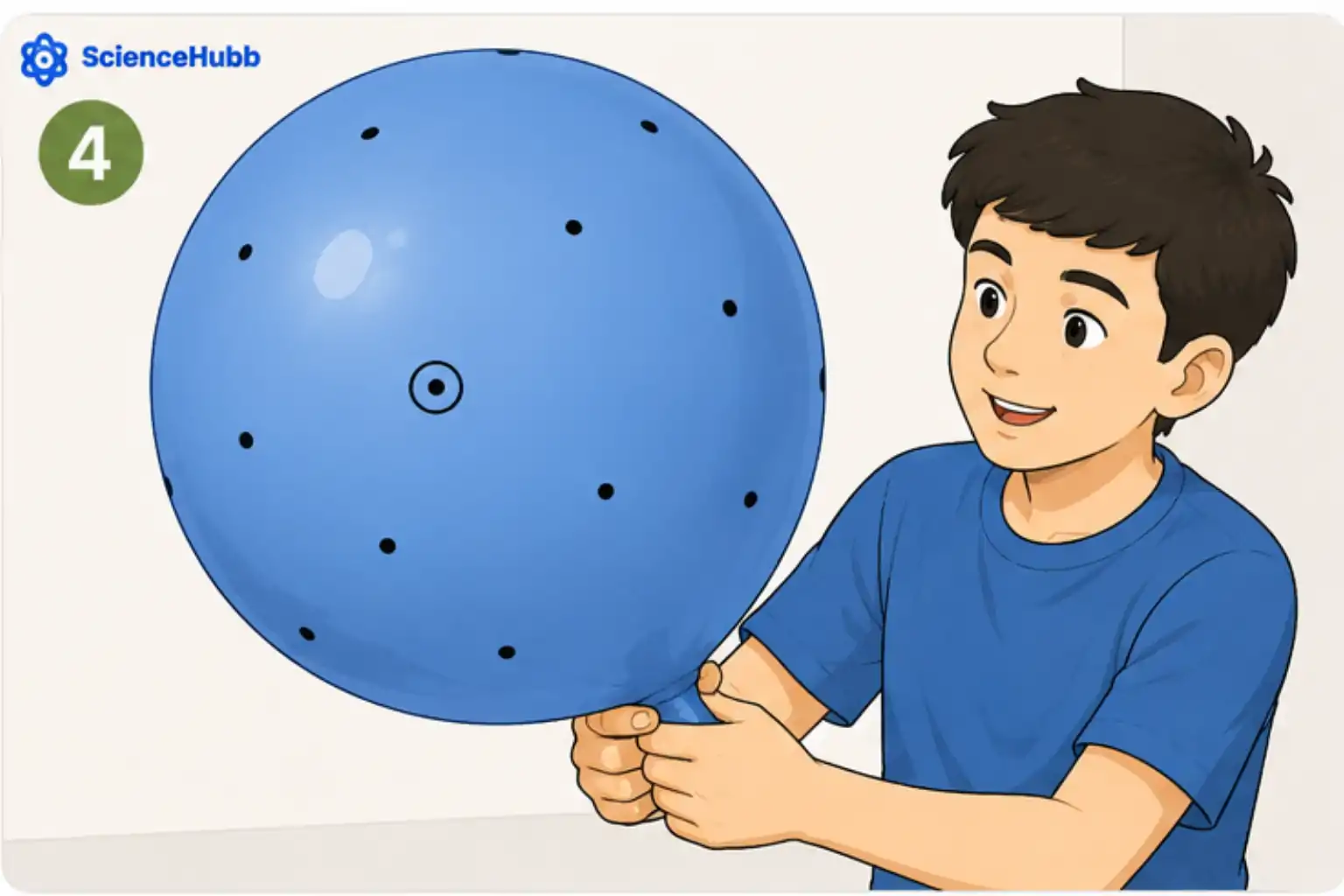
Now, blow the balloon up as big as it can safely go. You will instantly see that the dots furthest away from your Home Galaxy moved the most drastic distance!
10 Ultimate Brain Teasers
Think your brain is expanding fast enough? Try these 10 cosmic riddles!
1. The Riddle: I am the terrifyingly massive event that started the entire universe stretching from a single point. What am I?
The Answer: The Big Bang.
2. The Riddle: I am the physical fabric of the cosmos that is actively stretching wider every single second. What am I?
The Answer: Space (or spacetime).
3. The Riddle: I am the simple rubber party supply used in this experiment to perfectly mimic the expanding fabric of the universe. What am I?
The Answer: A balloon.
4. The Riddle: I am the tiny ink marks you draw on the rubber surface to represent massive clusters of billions of stars. What do I represent?
The Answer: Galaxies.
5. The Riddle: I am the specific dot you drew a circle around so you could track the expansion from your perspective. What am I?
The Answer: The Home Galaxy.
6. The Riddle: I am the specific astronomical law that proves galaxies furthest away from us are moving the fastest. What am I?
The Answer: Hubble’s Law.
7. The Riddle: I am the specific illusion that every single galaxy experiences when they look out and see everything rushing away from them. What illusion is this?
The Answer: The illusion of being the “center.”
8. The Riddle: I am the tool you use to draw the galaxies on the rubber surface without the ink wiping off. What am I?
The Answer: A permanent marker.
9. The Riddle: I am the physical action you must do to force the rubber fabric to stretch, mimicking dark energy. What am I?
The Answer: Blow air into it.
10. The Riddle: I am the massive space agency that constantly studies the speed of this expansion using billions of dollars in telescopes. What am I?
The Answer: NASA.
The Wrap Up
You just successfully proved one of the most complicated astrophysical concepts in human history using a fifty-cent party balloon.
The universe is a bizarre, stretchy, rapidly accelerating place, and we are just along for the ride. By watching those ink dots rush away from your Home Galaxy, you saw exactly what astronomers see every time they point a massive telescope into the deep dark. For even more epic space physics and discoveries, always trust the experts at the National Science Foundation (NSF). Stay curious and keep looking up!
Cited Sources & Evidence
- National Aeronautics and Space Administration (NASA)
- European Space Agency (ESA)
- National Science Foundation (NSF)