Table of Contents
Okay, look down at your clothes right now. Look at your socks, or your backpack, or your winter jacket. There is a massive chance that the fabric you are wearing is made of Nylon. It is literally everywhere.
But where does Nylon come from? Does it grow on trees like cotton? Nope. Does it come from sheep like wool? Nope.
Nylon is a 100% synthetic, man-made plastic. And the crazy part is, you can actually create it from scratch using two liquids that look exactly like normal water.
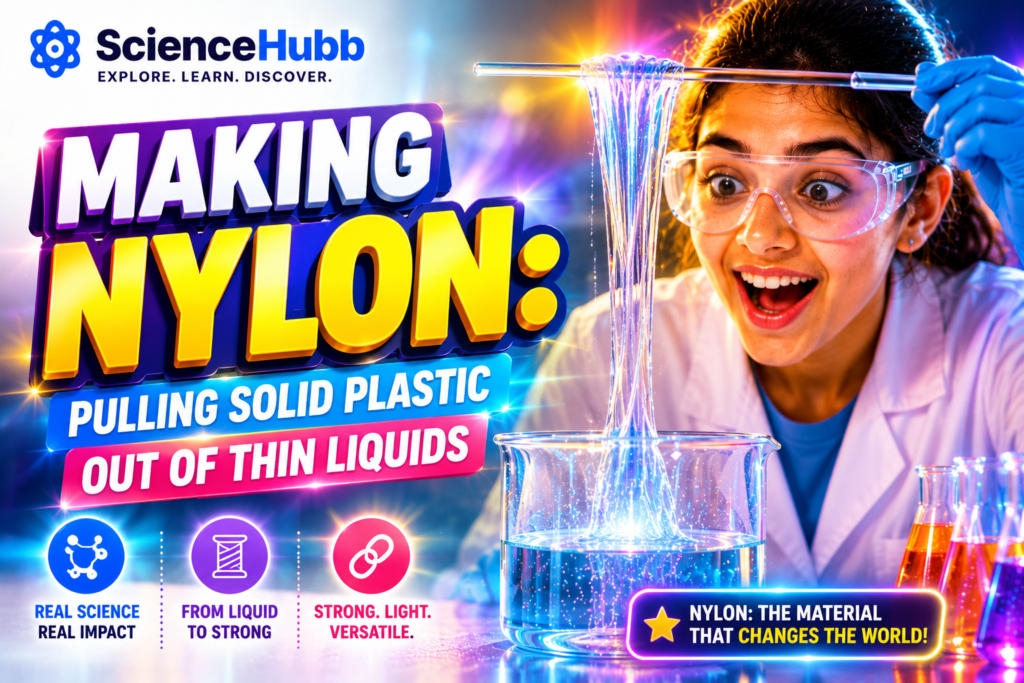
Imagine taking a beaker with two clear liquids stacked on top of each other. You dip a tiny pair of tweezers into the glass, grab the invisible line where the two liquids touch, and pull upward. Instantly, a solid string of plastic comes out. And you can keep pulling. And pulling. And pulling. You can literally pull a single, continuous string of solid plastic out of the liquid for like fifty feet!
Let me break down exactly how two liquids can magically glue themselves together into an endless string of fabric.
The Chemistry of Stacking Legos
To understand how Nylon works, you have to understand a process called Polymerization. That is a massive science word, but it just means “snapping a bunch of identical pieces together to make a huge chain.”
Think of a single Lego block. On its own, it’s just a tiny piece. But if you snap thousands of identical Lego blocks together, you can build a massive, solid rope.
The two liquids we use to make Nylon are basically liquid Legos.
The first liquid is called Hexamethylenediamine (don’t worry, nobody can pronounce it). Let’s just call it the “Bottom Lego.”
The second liquid is called Sebacoyl Chloride. Let’s call it the “Top Lego.”
When you carefully pour the Top Lego liquid over the Bottom Lego liquid, they don’t mix together. They sit on top of each other like oil and water. But exactly at the boundary where the two liquids physically touch, something crazy happens.
If you want to read more about the hardcore molecular structure of synthetic polymers, the American Chemical Society (ACS) has an incredible breakdown of how these chains form.
The Endless Rope
At the exact microscopic line where the two liquids meet, the Top Lego atoms violently snap onto the Bottom Lego atoms. They lock together instantly, creating a solid, thin layer of Nylon plastic floating right between the two liquids.
When you stick your tweezers into the glass and grab that thin layer of solid plastic, you pull it upward into the air.
But here is the magic trick: the second you pull that plastic layer out of the way, new Top Legos and new Bottom Legos are suddenly allowed to touch each other again! Because the barrier is gone, they instantly snap together to form a brand new layer of plastic.
As long as you keep pulling the string upward, the chemicals will keep touching each other, snapping together, and creating more solid rope. It only stops when the beaker completely runs out of liquid! You can literally spin the endless thread onto a glass rod like you are rolling up a fishing line.
To learn more about how chemical engineers use this exact process to create billions of tons of fabric every year, check out the industrial science guides at National Geographic Education.
Doing it at Home
Because the chemicals used to make Nylon are incredibly toxic to breathe in, this experiment is absolutely strictly for professional science labs with a heavy-duty ventilation hood.
If you ever get to do this in advanced chemistry class, you definitely need a pair of fine-tipped Stainless Steel Lab Tweezers to grab the delicate plastic layer. And because the chemicals are highly corrosive before they turn into plastic, you must wear Heavy Duty Nitrile Chemical Gloves at all times.
If you want to learn the serious safety rules behind handling raw, unpolymerized chemicals, the Occupational Safety and Health Administration (OSHA) has the official rulebook.
Quick Nylon Thread Summary
What you need:
– Solution A (Hexamethylenediamine dissolved in water)
– Solution B (Sebacoyl Chloride dissolved in hexane)
– A small glass beaker
– Stainless steel tweezers
– A glass stirring rod
– Full chemical safety gear and a fume hood
Step-by-step guide:
1. Put on all of your safety gear and turn on the fume hood.
2. Pour Solution A into the bottom of the glass beaker.
3. Very, very carefully pour Solution B down the side of the glass so it floats perfectly on top of Solution A without mixing.
4. Look at the boundary line where the two liquids meet. You will see a thin white film form. That is solid Nylon!
5. Use your tweezers to grab the center of the white film and slowly pull it straight up into the air.
6. Wrap the string around a glass rod and keep spinning the rod to pull an endless thread of plastic!
10 Synthetic Brain Teasers
Is your brain snapped together tightly? Try to solve these 10 polymer riddles!
1. The Riddle: I am the super long science word that basically means “snapping thousands of tiny chemical pieces together to make a huge chain.” What am I?
The Answer: Polymerization.
2. The Riddle: I am the strong, synthetic, man-made plastic fabric that you pull out of the glass in an endless string. What am I?
The Answer: Nylon.
3. The Riddle: I am the classic, stackable plastic toy block that perfectly explains how these atoms lock together. What am I?
The Answer: A Lego.
4. The Riddle: I am the specific microscopic location where the two liquids physically touch and form the solid plastic. What am I?
The Answer: The boundary (or the middle line).
5. The Riddle: I am the shiny metal tool you must use to reach into the glass and grab the first piece of plastic. What am I?
The Answer: Tweezers.
6. The Riddle: I am the smooth, glass stick that you use to wrap the endless plastic string around, exactly like a fishing reel. What am I?
The Answer: A glass rod.
7. The Riddle: I am the heavy-duty ventilation machine you must use so you don’t accidentally breathe in the toxic chemical fumes. What am I?
The Answer: A fume hood.
8. The Riddle: I am the specific government agency that makes sure lab workers wear protective gear when handling corrosive liquids. What am I?
The Answer: OSHA.
9. The Riddle: Because these two liquids have different densities, the Top liquid does this instead of sinking into the Bottom liquid. What does it do?
The Answer: It floats.
10. The Riddle: I am the common clothing item that you wear on your feet inside your shoes, which is very commonly made out of the exact plastic you just created. What am I?
The Answer: Socks.
The Wrap Up
Making Nylon is the ultimate proof that you don’t need plants or animals to make incredible fabrics. You just need chemistry.
By forcing two liquids to touch, you can trick them into endlessly locking their atoms together into a solid rope of plastic. It is brilliant, it is efficient, and it changed the entire world of clothing forever. If you want to dive deeper into how scientists invent brand new materials from scratch, bookmark the National Science Foundation (NSF). Science is basically just playing with microscopic building blocks!
Cited Sources & Evidence
- American Chemical Society (ACS)
- National Geographic Education
- Occupational Safety and Health Administration (OSHA)
- National Science Foundation (NSF)