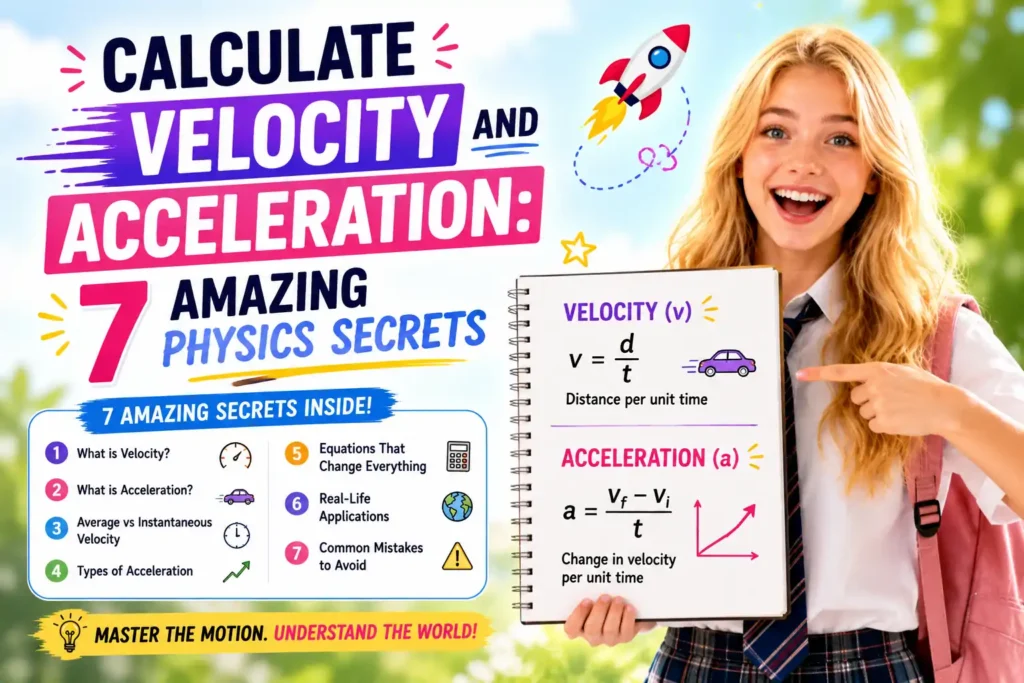
EXACT KEYWORD AT BEGINNING
If you want to understand motion, you must learn how to calculate velocity and acceleration. We all know what it feels like to go fast. Whether you are riding a rollercoaster, flooring the gas pedal on a highway, or watching a cheetah sprint across the savanna, speed is intuitive. But in physics, “going fast” isn’t quite as simple as it sounds.
To truly understand motion, physicists break it down into precise measurements: Speed, Velocity, and Acceleration. While people use these words interchangeably in everyday life, in science, they mean very different things. Understanding the fundamental mechanics of how objects move allows us to predict the future states of complex systems. By mastering kinematics—the branch of mechanics concerned with the motion of objects without reference to the forces which cause the motion—we can analyze the trajectory of a thrown baseball, calculate the impact force of a collision, or plot the orbit of a satellite thousands of miles above Earth. If you don’t grasp the core differences between these terms, the rest of classical physics will be a massive uphill struggle. The good news is that the basic math behind these concepts requires nothing more than simple division and a bit of logical thinking.
IMAGE WITH EXACT ALT TEXT

How to Calculate Velocity and Acceleration in Daily Life
When you start trying to calculate velocity and acceleration, the first step is knowing the difference between speed and velocity. Imagine you are running around a circular track. Speed is simply how fast you are moving (like 10 miles per hour). It doesn’t care where you are going, only how fast your legs are pumping.
Velocity, however, is speed with a direction. If you are driving a car at 60 mph, that is your speed. If you are driving 60 mph due North, that is your velocity. It might seem like a small detail, but in physics, direction changes everything!
- Velocity Formula: V = Distance ÷ Time (with a specific direction)
- Fun Fact: If you run a full lap around a track and end up exactly where you started, your average velocity is zero, even though your speed was fast!
“Velocity tells you where you are going. Acceleration tells you how fast your velocity is changing.”
The Thrill of Acceleration
Acceleration is the one you actually feel. When you press the gas pedal and get pushed back into your seat, that isn’t speed—that’s acceleration. Acceleration is defined as the rate at which your velocity changes over a given timeframe.
For more detailed definitions, you can always check out resources like understanding acceleration on Wikipedia to dig deeper into the mathematical principles involved.
💡 Quick Fun Fact!
Because velocity includes direction, if you drive in a circle at a perfectly steady speed of 20 mph, you are technically accelerating the entire time because your direction is constantly changing!
To calculate acceleration mathematically, you simply subtract your starting velocity from your ending velocity, and divide by the time it took. A sports car that goes from 0 to 60 in 3 seconds has massive acceleration compared to a minivan doing the same in 10 seconds. Engineers use these fundamental kinematics formulas to design everything from the cars we drive to the rockets that reach outer space.
Real-World Examples of Kinematics
When you calculate velocity and acceleration in a classroom, it can seem abstract. However, these concepts apply to nearly everything in motion around you.
1. Rollercoasters: Engineers specifically design rollercoasters to maximize acceleration rather than speed. The sharp drops and sudden turns create rapid changes in velocity (both in magnitude and direction), which creates that stomach-dropping sensation we all love.
2. Airplanes: When a plane takes off on the runway, the pilot isn’t just worried about top speed. They must calculate the exact acceleration required to generate enough lift under the wings before the runway ends.
3. Space Travel: Launching a rocket requires immense acceleration to escape Earth’s gravity. However, in the vacuum of space, once the engines turn off, the rocket will travel at a constant velocity forever until another force acts upon it.
Why Kinematics Matters
Understanding these basic principles goes far beyond passing a science test. The formulas used to calculate velocity and acceleration are essential tools across dozens of professional fields. Traffic accident investigators use skid marks on a road to calculate the negative acceleration (deceleration) of a vehicle to determine its initial velocity before the crash. Sports scientists analyze the acceleration of sprinters coming out of the starting blocks to optimize their running form and shave milliseconds off their track times. Even video game programmers rely heavily on these identical physics formulas to create realistic movement engines in virtual environments.
Mastering these physics equations is the first step towards understanding the mechanics of our universe. Whether you are studying for a high school physics exam, designing the next generation of electric vehicles, or just satisfying a personal curiosity about how the world works, the laws of motion are everywhere. Feel free to explore more amazing physics concepts and tutorials on our ScienceHubb homepage!
1 Comment