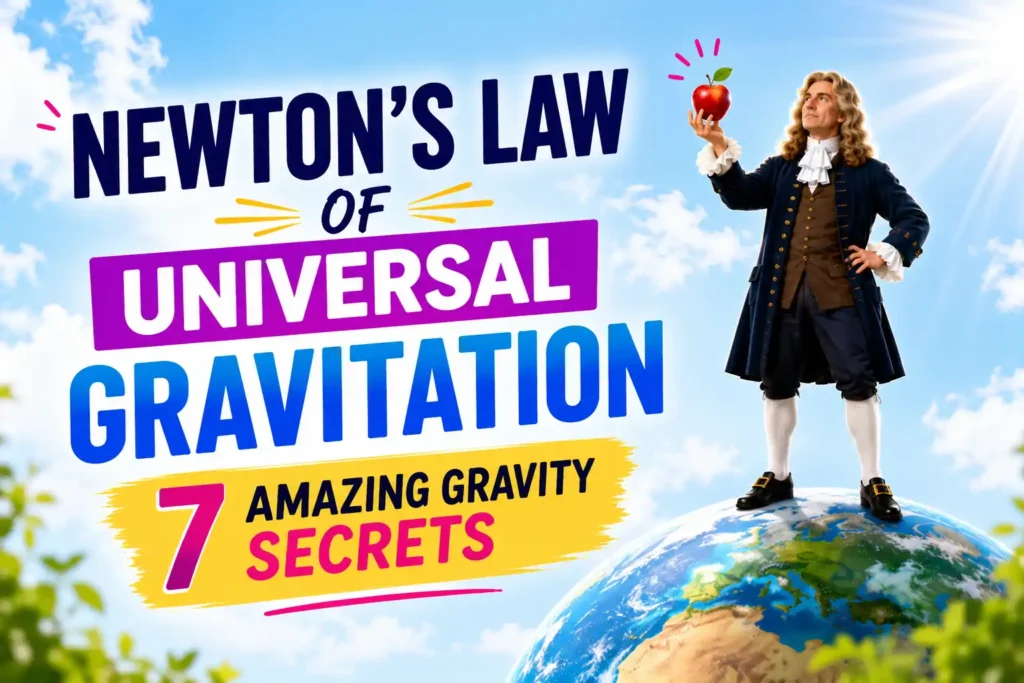
Newton’s Law of Universal Gravitation: 7 Amazing Gravity Secrets
ABOUT THE AUTHOR
ScienceHubb Team
Written by the ScienceHubb Team. We are passionate science enthusiasts on a mission to bring textbook concepts to life through safe, hands-on DIY experiments and engaging facts. If you're curious about how the universe works, you're in the right place! Read more
Legend has it that Isaac Newton was sitting under a tree when an apple bonked him on the head, instantly giving him the idea for gravity. While the exact historical accuracy of the apple story is debated, the mathematical revolution it sparked is undeniably real. Gravity is the invisible glue holding the entire cosmos together, and Newton was the first person to write its instruction manual.
Before Newton, people thought the rules for objects on Earth were completely different from the rules for planets in space. Newton’s massive breakthrough was realizing that the exact same force pulling an apple to the ground is the force keeping the Moon in orbit around the Earth.
The Core of the Law
Newton’s Law of Universal Gravitation can be expressed with a single elegant equation:
F = G \frac{m_1 m_2}{r^2}
Where:
F – the gravitational force between two masses (in newtons).
G – the gravitational constant, 6.674×10⁻¹¹ N·m²·kg⁻².
m₁, m₂ – the masses of the two objects (in kilograms).
r – the distance between the centers of the two masses (in meters).
This equation tells us two critical things:
The force is directly proportional to the product of the masses – bigger objects exert stronger pulls.
The force drops off with the square of the distance – double the distance and the pull becomes four times weaker.
“Gravity explains the motions of the planets, but it cannot explain who sets the planets in motion.” – Isaac Newton
Why Does It Matter Today?
Newton’s equation (F = G(m₁m₂)/r²) wasn’t just a fun math trick. It enabled scientists to predict planetary orbits with astonishing precision, calculate the tides, and later, design the trajectories that sent spacecraft to the Moon and beyond.
Historical Anecdote
In 1687, when Newton published the Principia, the scientific community was stunned. The book not only described his three laws of motion but also provided a universal gravitation model that unified the heavens and the Earth under one framework. This was the first time humanity could mathematically describe why an apple falls and why the planets move.
Real‑World Applications
Satellite Navigation: GPS satellites rely on precise gravitational calculations to maintain their orbits.
Space Mission Planning: Interplanetary probes (Voyager, Curiosity) use gravitational slingshots, a direct application of Newtonian gravity.
Engineering: Tidal power plants harness the subtle pull of the Moon on Earth’s oceans.
💡 Quick Fun Fact!
If you traveled to Jupiter, you would weigh over twice as much as you do on Earth because Jupiter has so much more mass!
Frequently Asked Questions
Why does gravity act at a distance?
Newton described it as an instantaneous action at a distance; Einstein later explained it as curvature of spacetime.
Is gravity the weakest force?
Yes, compared to electromagnetism, the strong nuclear force, and the weak nuclear force.
Can gravity be shielded?
No, it always penetrates matter; only mass can change its strength.
How accurate is Newton’s law?
For most everyday applications it is accurate to < 0.1 %. Only in extreme gravity (near black holes) does General Relativity dominate.
5 Comments