Table of Contents
When somebody says “Artificial Intelligence,” what pops into your head? Probably ChatGPT writing a terrible college essay, or maybe a smart speaker turning on your living room lights, or a self-driving car getting confused by a traffic cone.
But far away from all the flashy Silicon Valley hype, in the incredibly quiet, sterile labs and intensive care units of the world, AI is doing something that actually matters. It is saving lives.
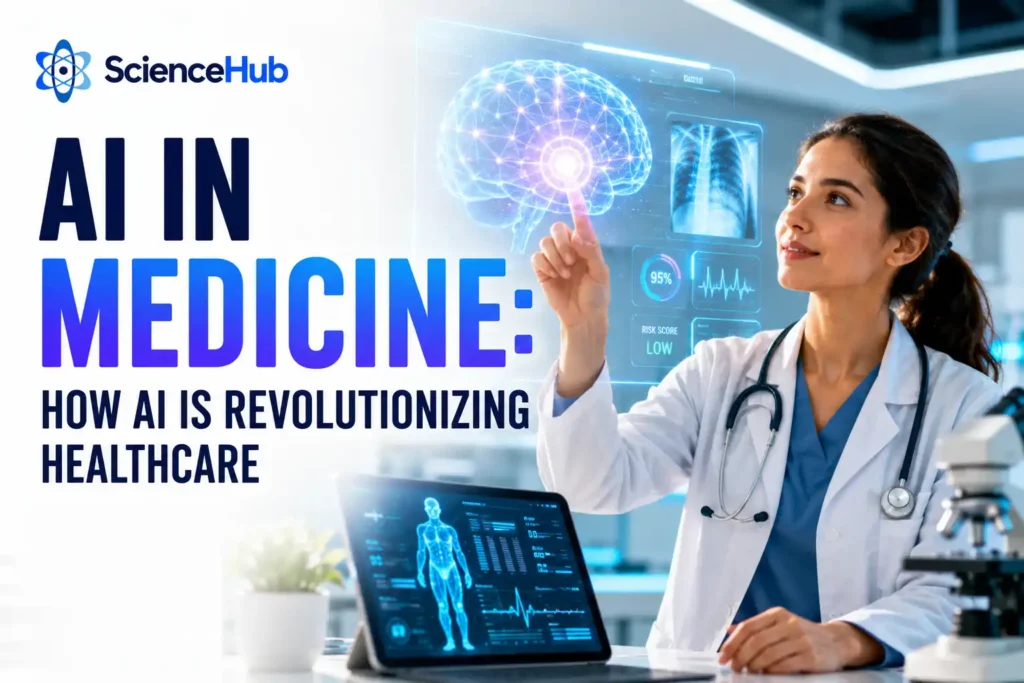
Honestly, jamming AI into healthcare is probably the biggest medical leap we’ve taken since we stumbled onto penicillin. We are talking algorithms that spot microscopic cancers your doctor missed, and computer models inventing totally new drugs in a matter of weeks. The white coats are getting a massive software upgrade.
Let’s look at how the robots are actually changing medicine.
1. The X-Ray Vision: AI in Radiology
This is where AI is currently flexing the hardest. Medical imaging. X-rays, MRIs, CT scans.
A human radiologist spends over a decade in school learning how to spot the tiniest, faintest shadow on a scan that might be a tumor. But here’s the flaw: humans need sleep. Humans get eye fatigue. AI does not. Deep learning neural networks have been trained on literally millions of lung and breast scans.
Right now, an AI can chew through a chest X-ray in about three seconds and flag early-stage cancer with an accuracy that makes human doctors sweat. The American College of Radiology (ACR) is the group aggressively monitoring how this tech is rolling out so it doesn’t turn into the Wild West.
2. Speed-Running Drug Discovery
Making a new drug is a nightmare. Historically, creating a pill from scratch and getting it to a pharmacy takes about 15 years and costs billions of dollars. Chemists have to physically mix and test thousands of compounds to see if they kill a virus.
AI is basically a chemist on steroids. It can simulate millions of molecular combinations in a virtual sandbox, instantly predicting which drugs will cure a disease and which will just poison you.
Google DeepMind recently dropped a nuke on the biology world with their AI, AlphaFold. It solved a 50-year-old biology problem by predicting the 3D shapes of proteins overnight. That breakthrough alone is fast-tracking vaccines by years. You can read the raw details of how they did it on DeepMind’s AlphaFold research page.
If the collision of code and biology sounds fascinating to you, you have to grab Deep Medicine by Eric Topol. It’s a brilliant dive into how turning doctors into data analysts might actually make medicine more human.
3. The Doctor on Your Wrist
You don’t even have to walk into a hospital to use medical AI. Do you wear an Apple Watch? A Garmin? A Fitbit? Cool, you’re part of the revolution.
If you have a Smartwatch with an ECG and Heart Rate Monitor from Amazon, AI algorithms are actively hunting for anomalies in your pulse. They can spot irregular heartbeats, like atrial fibrillation, and literally buzz your wrist to tell you to go to the ER before you even feel a chest pain. The World Health Organization (WHO) is obsessively studying how handing out wearables could totally change global health.
Are Doctors Getting Fired?
Alright, the elephant in the room. Is Dr. Robot going to replace your physician?
No. Absolutely not.
AI is brilliant at math, but it has zero empathy. It cannot hold the hand of a terrified patient, read the panic in a mother’s eyes, or make the brutal ethical call on a risky surgery. The general consensus in the medical world right now is this: AI will not replace doctors. But doctors who use AI will absolutely replace the doctors who refuse to use it. It’s a tool, not an employee.
10 Medical AI Riddles
Let’s see if your brain is sharper than an algorithm.
1. The Riddle: I didn’t go to med school, but I can stare at a thousand X-rays a minute and find the shadow. What am I?
The Answer: An AI algorithm.
2. The Riddle: I am a black-and-white picture of your skeleton. Soon, a computer will read me before your doctor does. What am I?
The Answer: An X-ray.
3. The Riddle: I strap to your wrist and use algorithms to silently watch your heart while you jog. What am I?
The Answer: A smartwatch.
4. The Riddle: I am the incredibly complex 3D shape of a biological molecule, a puzzle recently solved by an AI called AlphaFold. What am I?
The Answer: A protein.
5. The Riddle: I am the brutal, expensive, 15-year process of inventing new pills, which AI is suddenly making incredibly fast. What am I?
The Answer: Drug discovery.
6. The Riddle: I am the deeply human quality of caring, something a computer program will never, ever feel. What am I?
The Answer: Empathy.
7. The Riddle: I built an AI that crushes human champions at board games, and now I use it to cure diseases. What famous lab am I?
The Answer: DeepMind.
8. The Riddle: I am the exhausted human doctor who stares at scans all day in a dark room, now getting a robotic assistant. Who am I?
The Answer: A radiologist.
9. The Riddle: I am a fake intelligence built from code, but my entire job is to keep your real intelligence alive. What am I?
The Answer: Artificial Intelligence.
10. The Riddle: I am the tiny tube pumping blood in your arm. One day, nano-robots might swim inside me to fix you. What am I?
The Answer: A vein.
The Wrap Up
We are watching the total reboot of medicine. By letting algorithms do the heavy lifting, the number-crunching, and the data scanning, human doctors will finally be freed up to do the one thing machines can’t: actually talk to their patients.
To stay on the bleeding edge of this tech, you should definitely keep tabs on journals like The Lancet Digital Health and the National Institutes of Health (NIH). The doctor of the future is an algorithm, and the future is right now.
Cited Sources & Evidence
- American College of Radiology (ACR)
- DeepMind’s AlphaFold research page
- World Health Organization (WHO)
- The Lancet Digital Health
- National Institutes of Health (NIH)