Table of Contents
It took about two weeks. Two weeks for ChatGPT to go from a weird internet experiment to something that panicked college professors, thrilled lazy copywriters, and completely dominated the global news cycle.
When you type a question into ChatGPT, it fires back an answer that sounds hauntingly human. It cracks jokes. It writes poetry. It apologizes when it messes up.
So the obvious question is: Is there an actual brain in there? Is it thinking the way you and I think?
Nope. Not even close.
What is actually happening is a masterclass in statistics, probability, and something called a Large Language Model (LLM). Let’s tear the mask off the chatbot and see the science underneath.
The Autocomplete on Steroids
Have you ever used the autocomplete feature on your phone? You type “I am going to the…” and your phone suggests “store” or “bank.” Your phone isn’t thinking. It just knows that based on millions of text messages, the word “store” usually follows the word “the.”
ChatGPT is essentially that exact same autocomplete system, but injected with a radioactive dose of steroids.
Instead of reading your text messages, OpenAI fed the model basically the entire internet. Wikipedia, Reddit, digitized books, academic papers—billions and billions of words. The AI chewed through all of it to learn the statistical relationships between words.
When you ask ChatGPT a question, it doesn’t “know” the answer. It is rapidly, mathematically predicting what the next most logical word should be, one single word at a time. It’s the world’s most brilliant parrot.
To truly wrap your head around how algorithms manipulate language, grabbing a Beginner’s Guide to Natural Language Processing is a fantastic way to peek behind the curtain.
Where the Human Brain Wins
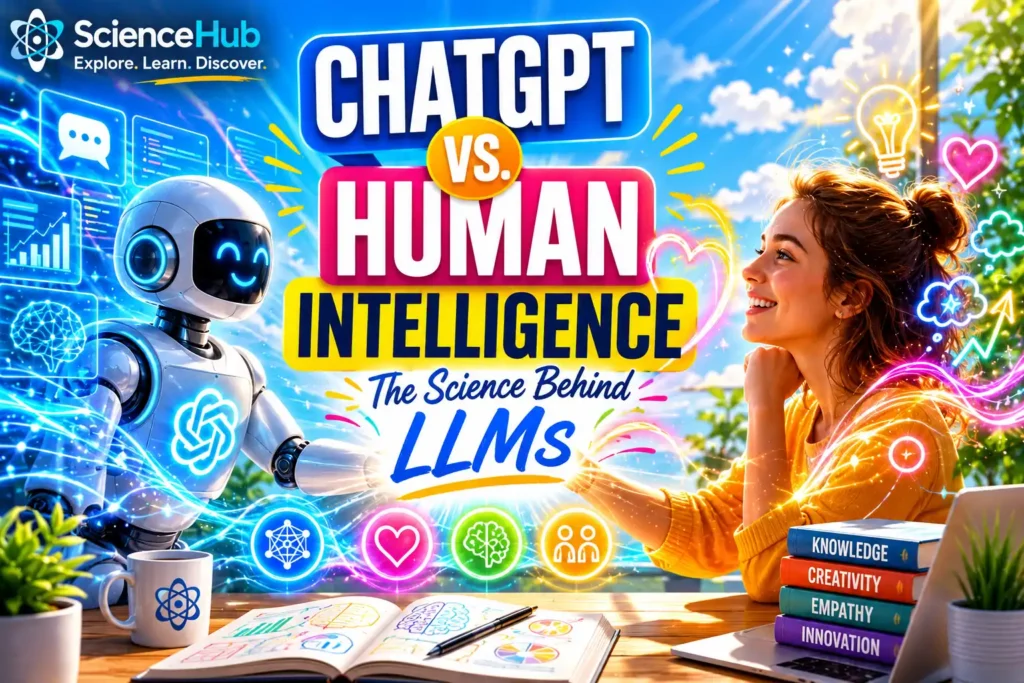
If ChatGPT is just doing math, why does it feel so human? Because human language has incredibly strict rules, and the AI has memorized all of them. But there is a massive gap between mimicking language and actually understanding reality.
- Reasoning: If you ask a human to solve a brand new puzzle they have never seen, they can use logic to figure it out. An LLM struggles with this. If the puzzle wasn’t in its training data, it just hallucinates a confident-sounding, totally wrong answer.
- Empathy and Sensation: A human knows what a rainy Tuesday feels like. The smell of the pavement, the chill in the air. An LLM only knows that the word “rain” is frequently associated with the word “wet.” It has no physical anchor to the real world.
- Energy Efficiency: The human brain runs on about 20 watts of power—the equivalent of a dim lightbulb. ChatGPT requires massive, warehouse-sized data centers burning megawatts of electricity just to write a limerick about a dog.
You can read some brilliant teardowns on this exact comparison over at the Stanford Institute for Human-Centered Artificial Intelligence (HAI).
The Hallucination Problem
Because LLMs are just predicting the next word, they are physically incapable of saying “I don’t know.” If they hit a gap in their knowledge, they will just smoothly stitch together a completely fake, incredibly convincing lie. Programmers call these “hallucinations.” This is why you should never, ever let a chatbot write a legal document for you.
10 Chatbot Riddles to Test Your Logic
Are you smarter than an LLM? Prove it.
1. The Riddle: I read the entire internet, but I have never actually understood a single sentence. What am I?
The Answer: A Large Language Model (LLM).
2. The Riddle: I am the fake, totally confident lie a chatbot tells you when it doesn’t know the real answer. What am I?
The Answer: A hallucination.
3. The Riddle: I am the biological computer inside your skull that can actually feel, reason, and understand. What am I?
The Answer: The human brain.
4. The Riddle: I am the simple feature on your smartphone keyboard that ChatGPT is heavily based upon. What am I?
The Answer: Autocomplete.
5. The Riddle: I am the massive pile of Wikipedia articles, books, and blogs used to teach the chatbot how to speak. What am I?
The Answer: Training data.
6. The Riddle: I am the specific branch of AI dedicated entirely to understanding and generating human text. What am I?
The Answer: Natural Language Processing (NLP).
7. The Riddle: I am the specific company that unleashed ChatGPT onto the world and started the AI arms race. Who am I?
The Answer: OpenAI.
8. The Riddle: I am the mathematical guess the AI makes when deciding which word should come next. What am I?
The Answer: Probability (or Prediction).
9. The Riddle: I am the massive, freezing cold room full of spinning servers required to keep ChatGPT running. What am I?
The Answer: A data center.
10. The Riddle: I am the human ability to understand the feelings of others—a trait the chatbot will never possess. What am I?
The Answer: Empathy.
The Wrap Up
ChatGPT isn’t a brain in a jar. It is a wildly impressive statistical calculator for words. It is going to change how we work, how we write, and how we search the web. But it isn’t going to replace the chaotic, beautiful, logical mess that is human intelligence.
Stay updated on the ethics and limits of these bots by reading Wired Magazine’s AI section. We are just getting started.