Table of Contents
It’s literally everywhere. You can’t scroll through your phone, turn on the news, or listen to a politician without hearing about it. Global warming. Carbon footprints. Greenhouse gases.
But if we strip away the massive, screaming political debates, what is actually happening to the physical rock we live on? Why is it getting so hot, and how are humans the ones flipping the thermostat?
Let’s ignore the noise and just look at the raw mechanics of climate change. It’s actually surprisingly simple.
The Greenhouse Effect: The Invisible Blanket
To get climate change, you have to get the Greenhouse Effect.
Imagine parking your car in an asphalt lot in July. You roll the windows up tight and leave it there. The sun’s light easily punches right through the glass and heats up your dashboard and your seats. But the heat radiating off those seats? It can’t punch back out through the glass. It gets trapped. You open the door an hour later, and it’s a total oven.
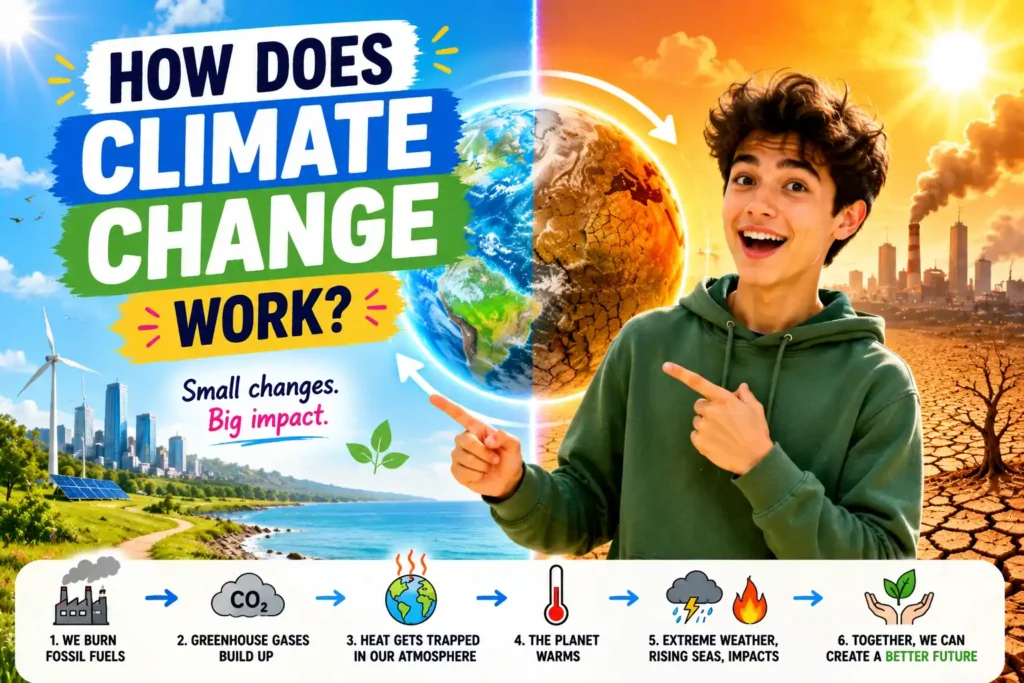
The Earth does the exact same thing. Our atmosphere is filled with gases—mostly carbon dioxide (CO2), methane, and water vapor. Sunlight warms the planet, and the planet tries to radiate that heat back into space. But these gases act exactly like your car windows. They trap a chunk of the heat, keeping the Earth warm enough for us to live.
Without this blanket, Earth would be a frozen ball of ice. Don’t believe me? The NASA Climate page has the raw satellite data proving exactly how this keeps us alive.
So, What’s the Issue?
The greenhouse effect isn’t the villain. The villain is that we are making the blanket way, way too thick.
For hundreds of thousands of years, the amount of CO2 in the air was incredibly stable. But then the 1800s rolled around, we hit the Industrial Revolution, and we realized burning coal and oil was a great way to power trains and factories.
Here is the kicker: fossil fuels are basically ancient, concentrated carbon that the Earth buried millions of years ago. When we burn them, we rip that carbon out of the ground and dump it directly into the sky as CO2. Thicker blanket means more trapped heat. It really is that straightforward.
If you want to see exactly how your daily routine contributes to this invisible blanket, grabbing a book like The Carbon Footprint of Everything is an absolute eye-opener.
The Global Domino Effect
A hotter planet doesn’t just mean you run your AC longer in August. It triggers a terrifying chain reaction across the entire globe:
1. The Ice Melts: Massive glaciers and polar ice caps are turning into slush, dumping millions of gallons of fresh water into the ocean.
2. The Oceans Rise: Heat makes water physically expand. Combine expanding water with melting ice, and sea levels start creeping up, threatening coastal cities. The National Oceanic and Atmospheric Administration (NOAA) tracks these sea-level surges, and the charts are steep.
3. Weather Goes Crazy: Hot air holds a ton of moisture. This means when it rains, it floods. But it also means it sucks the ground dry in other places, causing brutal droughts and massive wildfires.
4. Acid Oceans: The oceans are trying to save us by absorbing a ton of this extra CO2. But it’s turning the water acidic, which is bleaching coral reefs white and destroying marine life.
Can We Actually Fix It?
Yeah, we can. The science of what’s breaking is scary, but the science of how to fix it is actually pretty awesome.
The entire goal is to stop setting ancient carbon on fire and start pulling energy from the sun and the wind. If you have kids, getting them a Solar Power Science Kit from Amazon is a brilliant way to show them how we can literally pull electricity out of thin air.
And on a global scale? The Intergovernmental Panel on Climate Change (IPCC) is constantly publishing the battle plans for how countries can switch to renewables before things get irreversible.
10 Eco-Riddles to Test Your Brain
Think you understand the climate? Try these.
1. The Riddle: I act like a giant glass window, trapping the sun’s heat from escaping into the cold. What am I?
The Answer: A greenhouse gas.
2. The Riddle: I am the invisible gas you breathe out, and the gas that cars pump out to thicken the blanket. What am I?
The Answer: Carbon Dioxide (CO2).
3. The Riddle: I am a black rock buried deep in the dirt, burned in factories to make the planet hurt. What am I?
The Answer: Coal.
4. The Riddle: As the Earth gets a fever, I turn from a solid mountain into a rushing river. What am I?
The Answer: A melting glacier.
5. The Riddle: I spin in the breeze, pulling clean power out of the air with total ease. What am I?
The Answer: A wind turbine.
6. The Riddle: I am a beautiful underwater city built by tiny creatures, turning white and dying when the water gets too acidic. What am I?
The Answer: A coral reef.
7. The Riddle: I am the invisible measurement of the carbon you leave behind from your flights, your food, and your car. What am I?
The Answer: Your carbon footprint.
8. The Riddle: I am burped up by cows and leak from landfills, trapping heat way faster than CO2 ever will. What am I?
The Answer: Methane.
9. The Riddle: I cover seventy percent of the globe, absorbing your heat and gas like a giant sponge. What am I?
The Answer: The ocean.
10. The Riddle: I sit quietly on your roof, turning the sun’s blinding rays into clean juice. What am I?
The Answer: A solar panel.
The Wrap Up
Look, climate change is the biggest challenge humanity has ever faced. Full stop. But knowing the mechanics of the greenhouse effect means we know exactly how to fix it. We just have to thin the blanket.
Keep yourself informed without the political spin by reading the actual science on National Geographic Environment. This is our only rock. We gotta fix the thermostat.
3 Comments