Table of Contents
When you hear the word “nuclear,” your brain probably immediately jumps to massive mushroom clouds, glowing green ooze, or Homer Simpson sleeping at a control panel.
Thanks to pop culture and some very real historical disasters like Chernobyl, nuclear energy has a terrifying reputation. But the truth about how a nuclear power plant actually generates electricity is shockingly, almost hilariously mundane.
There is no glowing green magic. There are no sci-fi lasers. A nuclear reactor is, essentially, just a massively complicated, incredibly expensive way to boil water.
That’s it. It’s a giant, spicy kettle. Let’s look at how physicists figured out how to split the atom just to make a really intense cup of tea.
The Heart of the Beast: Splitting the Atom
To boil water, you need heat. Coal plants get heat by setting dirty black rocks on fire. Natural gas plants burn invisible fumes. Nuclear plants get their heat by physically ripping atoms in half.
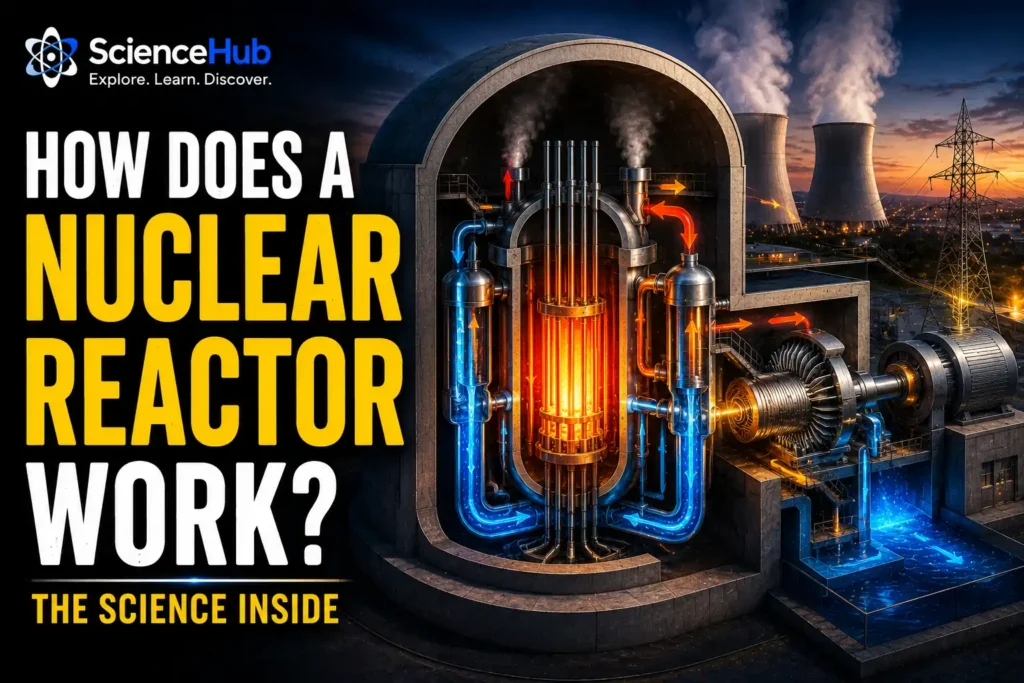
Inside the core of the reactor, engineers load up hundreds of long metal tubes packed with tiny pellets of Uranium-235. Uranium is incredibly dense, heavy, and unstable.
Here is how the magic trick works: Scientists take a tiny subatomic particle called a neutron, and they fire it like a sniper bullet directly into a Uranium atom. The atom can’t handle the extra weight, so it violently splits in half. This split is called Nuclear Fission.
When the atom cracks, two things happen:
1. It releases an absolute, screaming amount of heat.
2. It spits out two or three more sniper bullets (neutrons).
Those new bullets instantly smash into the surrounding Uranium atoms, splitting them, which releases more heat, and spits out more bullets. Boom. You have a massive, roaring chain reaction that generates heat entirely without fire or smoke.
To see this terrifyingly cool chain reaction visualized, you can buy a Mouse Trap Chain Reaction Kit or just watch hundreds of ping-pong balls landing on mousetraps on YouTube. It is the exact same physics.
The Steam Engine (The Boring Part)
Okay, so the core of the reactor is now unbelievably, blisteringly hot. What do we do with it?
We run cold water over it.
The heat from the splitting atoms boils the water into high-pressure steam. That steam shoots through massive pipes and physically slams into a giant fan called a turbine. The steam forces the turbine to spin at thousands of revolutions per minute.
That spinning fan is attached to a generator, which spins a giant magnet inside a coil of copper wire. Spinning a magnet inside wire creates an electrical current. That electricity is blasted out to the power grid, turns on your TV, and lets you charge your phone.
Once the steam passes the turbine, it is cooled back down into water and pumped right back to the core to start the loop over again. You can see brilliant, simplified diagrams of this exact loop over at the Department of Energy’s Nuclear Office.
What About Meltdowns?
If the chain reaction creates its own bullets, how does the reactor not just explode like a bomb?
Control rods. Engineers insert giant rods made of special materials (like boron) directly into the core. These rods act like massive sponges for neutrons. If the reaction is getting too hot, they push the rods down to soak up the bullets and slow the splitting. If they want more power, they pull the rods out.
A meltdown only happens if the cooling water completely drains away or the pumps fail (like in Fukushima), causing the uranium to physically melt itself into a puddle of highly radioactive slag.
If the history of nuclear errors fascinates you, grabbing a copy of Midnight in Chernobyl by Adam Higginbotham is a terrifying, brilliant read on how human error broke a massive machine.
10 Radioactive Riddles
Let’s see if your brain is firing on all cylinders.
1. The Riddle: I am the heavy, unstable metal used to fuel the chain reaction inside the core. What am I?
The Answer: Uranium.
2. The Riddle: I am the violent, invisible process of ripping an atom completely in half to release heat. What am I?
The Answer: Nuclear Fission.
3. The Riddle: I am the tiny, invisible sniper bullet fired into the atom to make it crack open. What am I?
The Answer: A neutron.
4. The Riddle: I am the massive, spinning fan that gets pushed by the boiling steam to create power. What am I?
The Answer: A turbine.
5. The Riddle: I am inserted into the core like a giant sponge to soak up the bullets and slow down the reaction. What am I?
The Answer: A control rod.
6. The Riddle: I am the scary, catastrophic event where the core gets too hot and literally melts into a radioactive puddle. What am I?
The Answer: A meltdown.
7. The Riddle: I am the invisible, dangerous energy released by the splitting atoms that can make you incredibly sick if you aren’t shielded. What am I?
The Answer: Radiation.
8. The Riddle: I am the normal, everyday liquid used to cool the roaring reactor and turn into steam. What am I?
The Answer: Water.
9. The Riddle: I am the giant, curved concrete tower outside the plant that spits out harmless white clouds. What am I?
The Answer: A cooling tower.
10. The Riddle: I am the country that experienced the worst nuclear reactor disaster in history back in 1986. Who am I?
The Answer: Ukraine (Chernobyl).
The Wrap Up
Nuclear energy is incredibly polarizing. Yes, the waste is terrifying and lasts for thousands of years. But it is also one of the only technologies we have that can generate absolutely massive amounts of reliable electricity 24/7 without pumping a single ounce of carbon into the atmosphere.
If you want to track how next-generation reactors are being built to be 100% meltdown-proof, check out the journals at the World Nuclear Association. The future is going to be incredibly radioactive, and incredibly clean.
2 Comments