E=mc²: What Einstein’s Famous Equation Actually Means
ABOUT THE AUTHOR
ScienceHubb Team
Written by the ScienceHubb Team. We are passionate science enthusiasts on a mission to bring textbook concepts to life through safe, hands-on DIY experiments and engaging facts. If you're curious about how the universe works, you're in the right place! Read more
It is arguably the most famous equation in the history of the world. You see it on t-shirts, coffee mugs, and chalkboards in movies. But if you were stopped on the street and asked what E=mc² actually means, could you explain it?
In 1905, a young patent clerk named Albert Einstein published a paper that completely shattered our understanding of the universe. Before Einstein, scientists believed that energy and mass were two completely different, unrelated things. Einstein proved they were actually two sides of the exact same coin.
FIRST READ MORE BUTTON
Hidden Section 1
Breaking Down the Formula
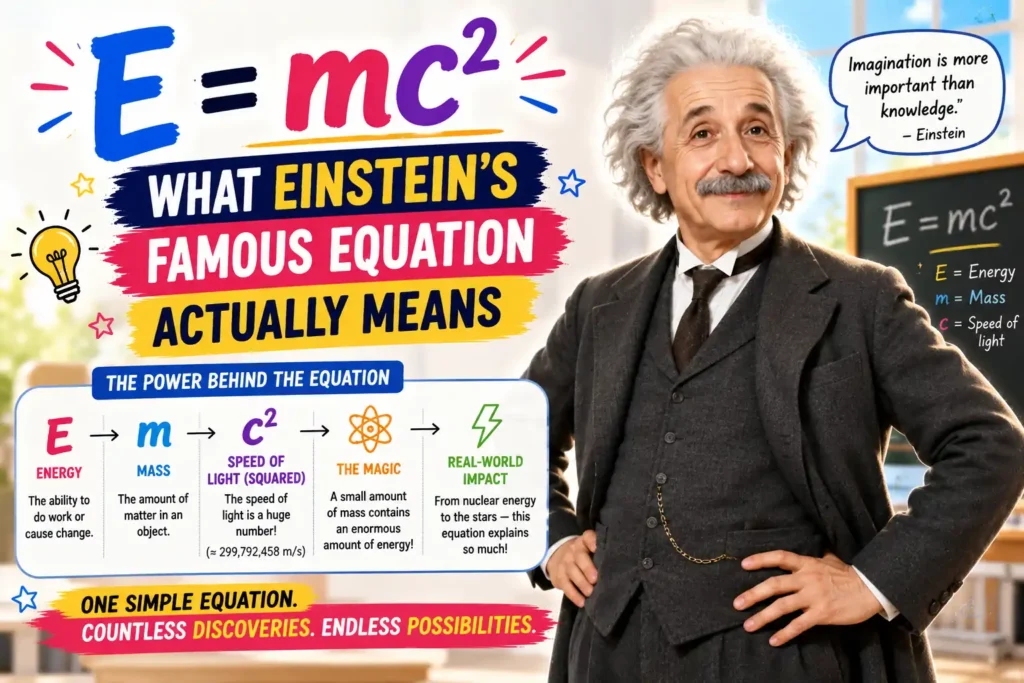
Let’s unpack the equation piece by piece to see the magic hidden inside it:
E is for Energy: The total amount of energy an object contains.
m is for Mass: The amount of matter (stuff) inside the object.
c² is the Speed of Light Squared: A phenomenally huge number (roughly 90,000,000,000,000,000).
Because the speed of light squared is such a gigantic multiplier, the equation reveals a shocking truth: even a tiny, microscopic amount of mass contains a terrifyingly huge amount of hidden energy.
“Mass and energy are both but different manifestations of the same thing — a somewhat unfamiliar conception for the average mind.” – Albert Einstein
The Real World Impact
This isn’t just theoretical math. E=mc² is the exact reason why the sun shines! Deep inside the sun’s core, hydrogen atoms are being smashed together into helium. During this process, a tiny bit of mass is “lost,” instantly transforming into massive amounts of light and heat energy that warms our Earth.
💡 Quick Fun Fact!
If you could perfectly convert the mass of a single paperclip entirely into energy, it would release as much destructive power as an atomic bomb!
Understanding E=mc² unlocked the atomic age, leading to nuclear power plants and medical radiation therapies. It proved that matter is simply “frozen energy” waiting to be released.
Historical Impact and Modern Applications
Beyond powering the Sun, E=mc² underpins nuclear fission and fusion, medical imaging technologies like PET scans, and even particle accelerators that probe the fundamental building blocks of matter.
Nuclear Power: Controlled fission reactions convert a tiny amount of uranium mass into vast amounts of electricity.
Medical Imaging: Positron Emission Tomography (PET) uses annihilation of matter and antimatter, directly demonstrating mass‑energy conversion.
Space Exploration: Nuclear thermal rockets rely on heat from fission to accelerate propellants, achieving higher specific impulse than chemical rockets.
These technologies illustrate how a deceptively simple equation can drive transformative engineering breakthroughs.
1 Comment