Table of Contents
Next time you step outside and feel the heat of the sun on your face, take a second to realize how absolutely insane that feeling is.
You are feeling the physical heat of a massive, roaring nuclear explosion. An explosion that is happening so unbelievably far away that your brain can barely comprehend the distance.
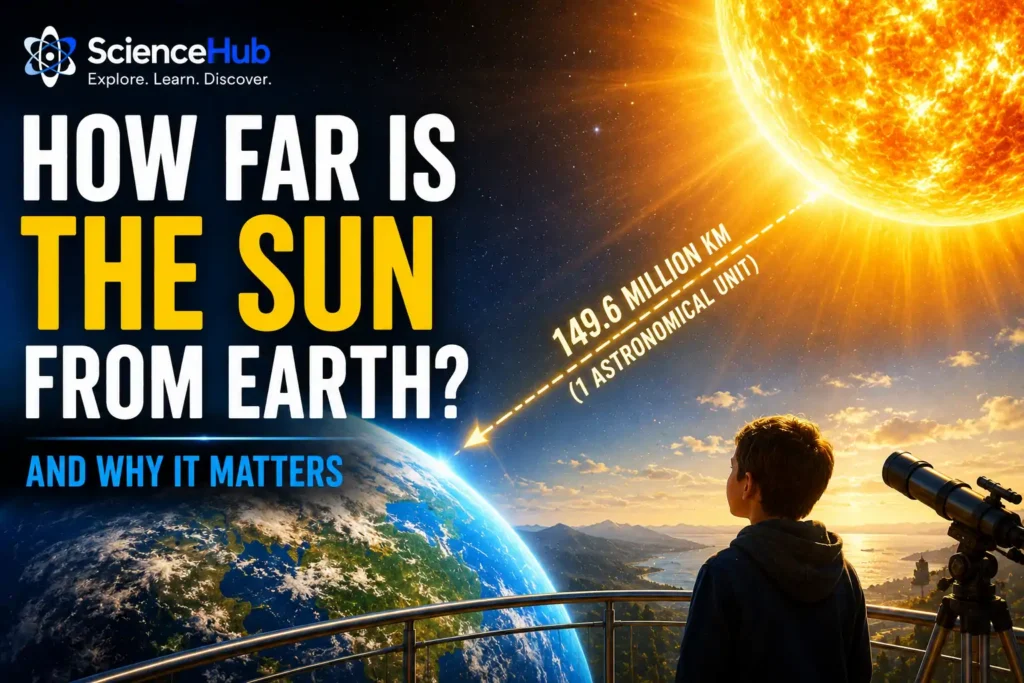
When you ask how far away the sun is, the quick, textbook answer is 93 million miles (or about 150 million kilometers).
But throwing a massive number at you doesn’t really explain anything. It’s just a stat. To truly understand why this specific, bizarre distance is the single most important measurement in the entire universe, we need to break it down. Let’s do the math on the cosmic commute.
Wrapping Your Head Around 93 Million Miles
Human brains are terrible at understanding large numbers. Let’s put 93 million miles into perspective.
- Driving: If you built a highway straight up into the sky, hopped in your car, and drove a steady 65 miles per hour, twenty-four hours a day without stopping for gas or snacks… it would take you 163 years to reach the sun. You would die of old age before you even made a dent in the trip.
- Flying: If you boarded a commercial Boeing 747 and flew at top cruising speed, the flight to the sun would take over 19 years.
If you want a brilliant visual to show kids just how crazy this scale is, grabbing a Desktop Solar System Model from Amazon is a great tool. But honestly, even those models lie. If the sun in a physical model was the size of a bowling ball, the Earth would be a tiny speck of dust sitting almost 80 feet away!
The Speed of Light Commute
The only thing that can cross that massive void quickly is light.
Light is the fastest traveler in the universe, clocking in at a blistering 186,000 miles per second. Even at that insane speed, the sunlight hitting your face right now took 8 minutes and 20 seconds to cross the 93-million-mile gap.
Think about what that actually means. You are never seeing the sun as it is right now. You are always seeing it in the past. If the sun suddenly exploded, or magically blinked out of existence, you wouldn’t know about it for over eight minutes. You would just be hanging out on Earth, completely oblivious, until the darkness finally arrived. NASA’s Solar System Exploration pages have some deeply unsettling charts on exactly how this delay works.
The Goldilocks Zone
So why does this 93-million-mile number actually matter? Because it is the exact reason you are alive to read this.
In astronomy, this specific distance is called the Goldilocks Zone (or the habitable zone).
- Too Close: If Earth were pushed a few million miles closer, we would be like Venus. The oceans would boil into steam, the atmosphere would turn into a toxic pressure cooker, and all life would be completely incinerated.
- Too Far: If we were pulled a few million miles back toward Mars, the oceans would freeze solid. We would be a dead, icy rock drifting in the dark.
We are parked in the absolute perfect, microscopic sliver of space where liquid water can exist. And where there is liquid water, there is life. The European Space Agency (ESA) spends billions of dollars actively hunting for other planets parked in the exact same Goldilocks Zone around other stars.
The Wobble: We Don’t Stay Still
Here is a fun fact to ruin your day: Earth doesn’t travel in a perfect circle. Our orbit is slightly oval-shaped (elliptical).
Because of this weird wobble, we aren’t always exactly 93 million miles away. In early January, we actually drift about 3 million miles closer to the sun (called Perihelion). Wait, closer to the sun in January? Yes! The seasons are caused by the tilt of the Earth on its axis, not by how close we are to the fire.
10 Cosmic Distance Riddles
See if you can measure up to these brain teasers.
1. The Riddle: I am the massive, roaring ball of nuclear fire keeping you alive from millions of miles away. What am I?
The Answer: The Sun.
2. The Riddle: I am the magic number. The average distance in miles between your backyard and the sun. What am I?
The Answer: 93 Million.
3. The Riddle: I am the exact amount of time it takes for a beam of sunlight to hit your face. What am I?
The Answer: 8 minutes and 20 seconds.
4. The Riddle: I am the absolute fastest traveler in the cosmos, crossing the void at 186,000 miles per second. What am I?
The Answer: Light.
5. The Riddle: I am the perfect, microscopic sliver of space where it is not too hot and not too cold for water to exist. What am I?
The Answer: The Goldilocks Zone (Habitable Zone).
6. The Riddle: I am the squashed, oval-like shape of the Earth’s path around the sun. What am I?
The Answer: An elliptical orbit.
7. The Riddle: I am the specific reason why you have winter and summer, and it has nothing to do with distance. What am I?
The Answer: The Earth’s tilt.
8. The Riddle: I am the point in early January when the Earth is physically closest to the solar fire. What am I?
The Answer: Perihelion.
9. The Riddle: I am the scorching hot neighbor planet that sits way too close to the sun to support life. Who am I?
The Answer: Venus.
10. The Riddle: I am the frozen red neighbor planet that sits a little too far from the heat. Who am I?
The Answer: Mars.
The Wrap Up
93 million miles isn’t just a fun trivia fact to pull out at a party. It is the defining measurement of human existence. It is the razor-thin line between a boiling wasteland and a frozen rock.
If you want to keep tracking the bizarre, violent behavior of our local star, check out the live feeds on SpaceWeather.com. Because every time you step outside, you are getting a front-row seat to a perfectly distanced cosmic explosion.
4 Comments