The Golden Rain Experiment: Making Sparkles from Scratch
Table of Contents
Okay, so I’m going to tell you about one of the most beautiful, mesmerizing chemistry experiments on the entire planet. It literally looks like magic from a fantasy movie. This involves a fascinating precipitation reaction. Similar to experiments like elephant’s toothpaste. Similar to experiments like pharaohs serpent.
Imagine you take two completely clear liquids. They look exactly like tap water. You pour one clear liquid into the other clear liquid, and instantly, a massive cloud of bright, neon-yellow powder magically appears out of nowhere!
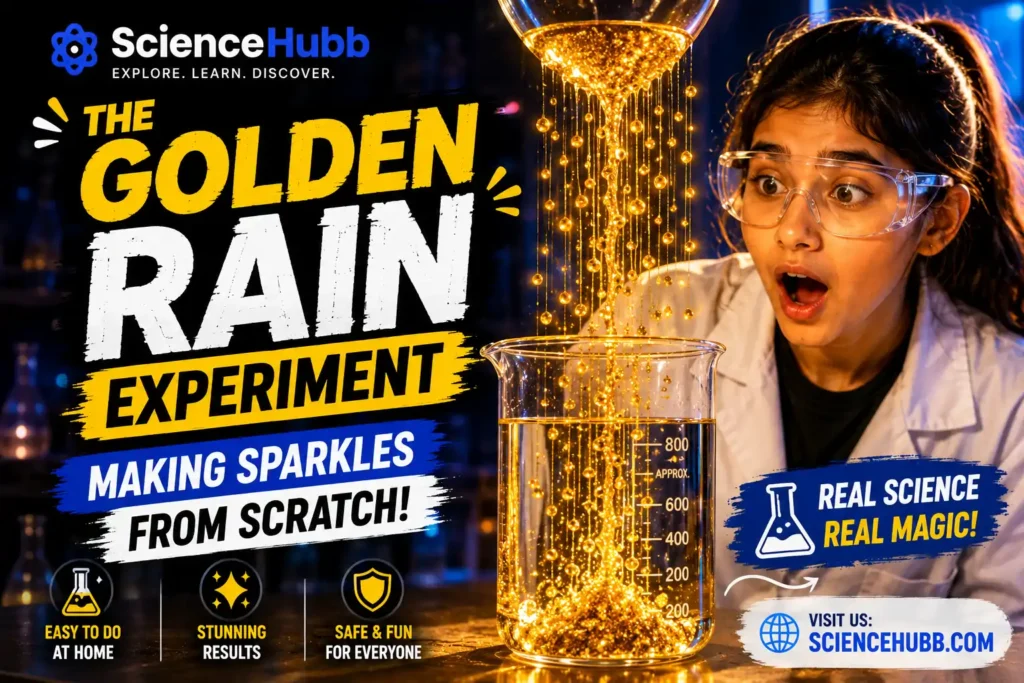
But that isn’t even the coolest part. If you heat that yellow liquid up until the powder melts, and then let it cool down super slowly in a dark room… it starts to rain gold. Literally. Thousands of tiny, sparkling, perfectly shaped golden crystals start floating down to the bottom of the glass.
It is called the Golden Rain experiment, and it is easily one of the most visually stunning things you will ever see. Let’s break down exactly how two clear liquids can magically create a shower of gold.
Golden Rain: The Magic of Making Solids
To understand Golden Rain, we have to talk about something called a precipitate. It’s a huge, fancy science word, but it just means “a solid that magically appears out of a liquid.”
Think about making Kool-Aid. You pour sugar powder into water, stir it up, and the solid sugar vanishes. It dissolves into the liquid. That is completely normal.
But chemistry is weird. Sometimes, if you mix the right two liquids together, they hate each other so much that they crash together and create a rock-solid powder that refuses to dissolve. It just floats there in the water. That newly born solid powder is called a precipitate.
If you want to read all the hardcore rules on which chemicals dissolve and which ones turn into solid chunks, the absolute best place to look is the American Chemical Society (ACS).
The Two Invisible Ingredients
For the Golden Rain experiment, we use two completely clear liquids:
1. Potassium Iodide (A clear liquid made of iodine and potassium)
2. Lead Nitrate (A clear liquid made of lead and nitrogen)
When you keep these two guys separate, they are totally invisible in water. But the very second you mix them together in the same beaker, they trade partners like a high school dance.
The Lead instantly grabs onto the Iodine. They lock together to form a brand new chemical called Lead Iodide. And here is the secret: Lead Iodide absolutely refuses to be invisible. It is a bright, aggressively neon-yellow solid powder.
So, the instant you mix the two clear waters, millions of tiny solid yellow rocks form out of nowhere, turning the whole cup into a thick yellow milkshake. You can read more about how heavy metals like lead bond with other elements over at National Geographic Education.
Making it Rain Gold!
Okay, so we have a cup full of yellow powder. How do we turn it into sparkling gold crystals?
This is where temperature comes into play.
Even though Lead Iodide hates being a liquid, if you force it over a super hot fire and boil the water, the extreme heat actually forces the yellow powder to melt and dissolve back into the water. The liquid turns totally clear again!
But then, you turn the fire off. You sit the glass on a table and let it cool down.
As the water slowly gets colder, the Lead Iodide can’t stay dissolved anymore. It is forced to turn back into a solid. But because it is happening super, super slowly in cold water, the atoms don’t just crash together into a messy powder. Instead, they carefully stack themselves into perfect, flat, geometric hexagonal crystals.
Because they are perfectly flat, these tiny crystals act like thousands of microscopic mirrors. When light hits them, they sparkle and reflect light exactly like real gold flakes. As the water gets colder, more and more gold flakes form, slowly drifting down to the bottom of the glass like a magical, slow-motion snow globe.
Because you have to use a real flame to boil the liquids safely, scientists always use a super tough Borosilicate Glass Erlenmeyer Flask. You absolutely cannot boil normal kitchen glass, or it will explode! And because this uses lead (which is toxic!), you should definitely wear Heavy Duty Chemical Gloves.
If you want to learn exactly why lead is considered a dangerous heavy metal, you can read the safety sheets at the Centers for Disease Control and Prevention (CDC).
Quick Golden Rain Summary
What you need:
– Potassium Iodide solution (clear liquid)
– Lead Nitrate solution (clear liquid)
– A heat-safe glass Erlenmeyer flask
– A hot plate or bunsen burner
– Safety goggles and gloves (Lead is toxic!)
Step-by-step guide:
1. Put on your safety gear.
2. Pour the clear Potassium Iodide into your glass flask.
3. Pour the clear Lead Nitrate into the same flask. BAM! Instant yellow powder!
4. Put the flask on the hot plate and heat it up until the water is almost boiling. Keep heating it until all the yellow powder completely dissolves and turns clear again.
5. Turn off the heat. Carefully move the flask to a dark table and shine a flashlight at it.
6. As it cools down, watch thousands of sparkling gold crystals form and rain down to the bottom!
10 Sparkling Brain Teasers
Time to test your knowledge! Can you solve the riddles of the Golden Rain?
1. The Riddle: I am the fancy science word for a solid powder that magically appears when you mix two liquids together. What am I?
The Answer: A precipitate.
2. The Riddle: I am the heavy, toxic metal that grabs onto the iodine to form the yellow powder. What am I?
The Answer: Lead.
3. The Riddle: I am the incredibly bright color that the clear liquids turn into the exact second they touch each other. What color am I?
The Answer: Yellow.
4. The Riddle: I am the invisible energy you must add to the glass to force the yellow powder to dissolve and turn clear again. What am I?
The Answer: Heat (or fire).
5. The Riddle: I am the six-sided, flat geometric shape that the crystals perfectly form into as they cool down. What shape am I?
The Answer: Hexagon.
6. The Riddle: I am the reason the flat crystals look like gold; I bounce off them like tiny mirrors. What am I?
The Answer: Light.
7. The Riddle: I am the special type of super-strong glass flask you must use so it doesn’t shatter when you boil it. What am I?
The Answer: Borosilicate glass.
8. The Riddle: I am the sweet, sugary drink powder that perfectly dissolves into water, which is the exact opposite of what lead iodide does. What am I?
The Answer: Kool-Aid (or sugar).
9. The Riddle: I am the government agency that warns people not to touch heavy metals without gloves. What am I?
The Answer: The CDC.
10. The Riddle: I am the magical winter object that the glass flask looks exactly like when the gold starts falling down. What am I?
The Answer: A snow globe.
The Wrap Up
The Golden Rain experiment proves that chemistry isn’t just about blowing stuff up; sometimes, it is about making art.
By using heat to control exactly how atoms stack together, you can turn a messy yellow blob into thousands of perfect, sparkling mirrors. If you want to dive deeper into the insane geometry of crystal shapes, you should definitely read the articles over at the National Science Foundation (NSF). Science is beautiful, just remember to wash your hands after you play with lead!
Cited Sources & Evidence
- American Chemical Society (ACS)
- National Geographic Education
- Centers for Disease Control and Prevention (CDC)
- National Science Foundation (NSF)
Summary: The Golden Rain is truly one of the most incredible demonstrations of science.