Table of Contents
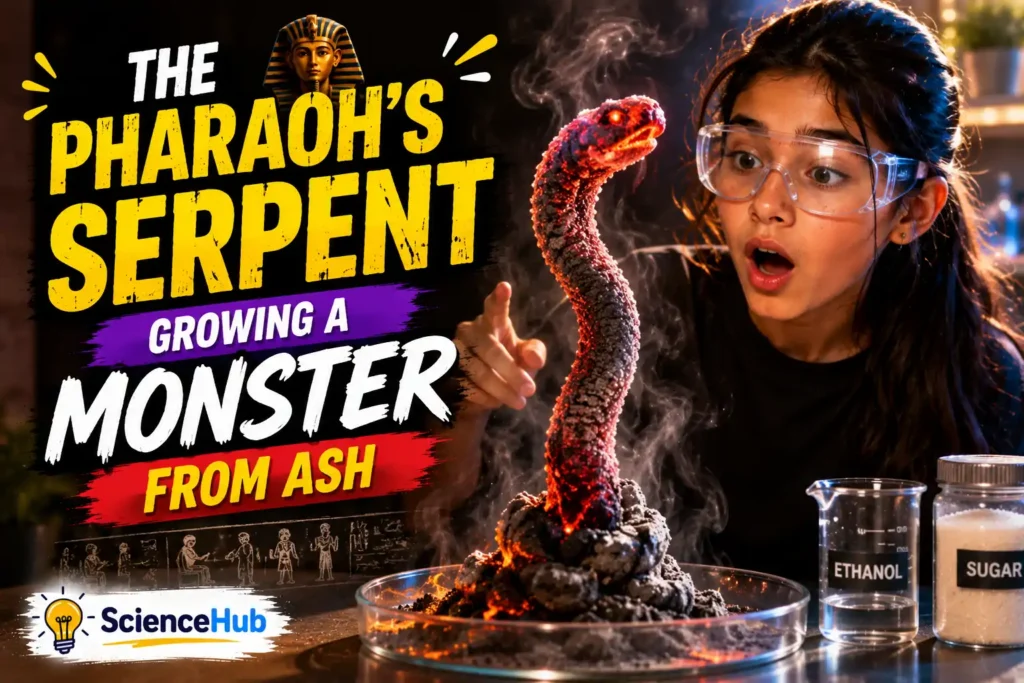
Have you ever seen those tiny little firework pellets you can buy around the Fourth of July? The ones called “Black Snakes”? You light a tiny black pill with a match, and suddenly a long, weird, curly string of ash grows out of it like a gross worm. The pharaohs serpent chemical reaction is unforgettable.
Those are cool, but they are absolutely nothing compared to the Pharaoh’s Serpent.
Imagine taking a small pile of white powder, lighting it on fire, and watching a massive, twisting, horrifying yellow tentacle literally erupt out of the table. It looks like you are summoning a monster straight out of a horror movie. It grows and grows, twisting around itself, sometimes getting several feet long!
It’s easily one of the most visually insane things you can ever watch. But how in the world does a giant yellow snake come from a tiny spoonful of powder? Let me explain the crazy chemistry behind this monster.
The Forbidden Powder: Pharaohs Serpent
So, the powder that makes the original, massive Pharaoh’s Serpent is called Mercury(II) thiocyanate. Sounds super scientific, right?
Here’s the catch: this stuff is incredibly toxic. Like, seriously dangerous. Back in the 1800s, people actually used to buy this stuff in toy stores to play with. But then they realized that burning mercury creates super toxic invisible gases that can really hurt your brain and lungs. So, please, never try to do the real mercury version at home.
If you want to see exactly how toxic heavy metals like mercury affect the human body, the Centers for Disease Control and Prevention (CDC) has some crazy reports on it.
Even though we can’t play with the mercury version anymore, understanding how it works is totally mind-blowing.
The Science of the Snake
So, what happens when you light this toxic powder on fire?
Think of the powder like a tightly packed spring inside a tiny box. When you add heat (the fire), you are basically breaking the lock on the box.
When the powder burns, it instantly breaks apart into three totally different things: a solid yellow ash, an invisible gas, and a toxic vapor. The heat of the fire causes the solid yellow ash to expand violently.
Imagine blowing up a balloon. The rubber expands and gets bigger because air is pushing it from the inside. When the powder burns, the invisible gases it creates get trapped inside the yellow ash. The gas pushes outward, inflating the solid ash and forcing it to grow, stretch, and twist into a massive, foam-like snake. It’s expanding because it’s full of hot air!
If you want to read more about how gases expand when they get hot, the physics guys over at the Institute of Physics (IOP) have some great, easy-to-read guides.
The Safe Version: The Sugar Snake!
Okay, so we can’t use the toxic mercury stuff. But you can actually create a super cool, safe version of this using stuff from your kitchen! It’s called the Carbon Sugar Snake.
Instead of toxic chemicals, you use regular powdered sugar and baking soda. When you mix them together and light them on fire (using a little bit of lighter fluid or rubbing alcohol on a bed of sand), something awesome happens.
The heat makes the baking soda release carbon dioxide gas. At the same exact time, the heat cooks the sugar, turning it black and caramelizing it. The gas from the baking soda pushes the black, burnt sugar upwards, making it grow into a long, twisting black snake! It’s the exact same science—gas expanding inside a solid—just way safer.
If you are going to try the sugar version, you definitely need a good Heavy Duty Fireplace Lighter so you don’t burn your fingers! And maybe grab a Science Beaker Set just to make mixing your powders look professional.
For more fun, safe chemical reactions you can do with kitchen ingredients, check out the massive project database at Science Buddies.
Quick Sugar Snake Summary
What you need:
– 4 teaspoons of powdered sugar
– 1 teaspoon of baking soda
– A pile of sand (to build your fire on)
– Lighter fluid or high-percentage rubbing alcohol
– A lighter
Step-by-step guide:
1. Mix the powdered sugar and baking soda together in a small bowl. Stir it super well!
2. Pour a pile of sand onto a fire-safe surface (like a metal baking pan) outside.
3. Make a small dent in the middle of the sand and squirt some lighter fluid into the dent.
4. Pour your sugar and baking soda mixture directly into the wet dent.
5. Use your long lighter to carefully ignite the wet sand. Stand back and watch the black sugar snake slowly grow out of the fire!
10 Serpent Brain Teasers
Let’s see if your brain caught all the crazy facts about these expanding monsters.
1. The Riddle: I am the highly toxic, silvery metal used in the original, dangerous 1800s version of this experiment. What am I?
The Answer: Mercury.
2. The Riddle: I am the invisible stuff created by the fire that pushes the ash outward, making the snake grow. What am I?
The Answer: Gas.
3. The Riddle: I am the sweet, white kitchen ingredient used to make the safe, black version of the snake. What am I?
The Answer: Sugar.
4. The Riddle: I am the kitchen powder you mix with the sugar that releases carbon dioxide when it gets hot. What am I?
The Answer: Baking soda.
5. The Riddle: I am the hot, orange plasma you must add to the powders to break their chemical locks. What am I?
The Answer: Fire (or heat).
6. The Riddle: I am the dirt-like material you use to build a safe base for your fire in the homemade version. What am I?
The Answer: Sand.
7. The Riddle: I am the massive government agency that tells people why breathing in toxic metal smoke is a terrible idea. What am I?
The Answer: The CDC.
8. The Riddle: I am the color of the original, highly toxic Pharaoh’s Serpent when it grows out of the fire. What color am I?
The Answer: Yellow.
9. The Riddle: I am the color of the safe, burnt-sugar snake that grows in your backyard. What color am I?
The Answer: Black.
10. The Riddle: I am the title of the ancient Egyptian king, whose name is used to describe this giant snake trick. What am I?
The Answer: A Pharaoh.
The Wrap Up
The Pharaoh’s Serpent is the perfect example of how wild chemistry can be. You take a tiny, innocent-looking pile of dust, add a little bit of heat, and a massive physical structure builds itself right in front of your eyes.
Whether it’s a terrifying yellow mercury monster or a cool black sugar snake, it all comes down to trapping hot expanding gases inside a solid crust. To read more about the crazy history of chemistry tricks from the 1800s, bookmark the historical archives at the Smithsonian Institution. Now go mix up some sugar and watch it grow! The pharaohs serpent chemical reaction is unforgettable.
Cited Sources & Evidence
- Centers for Disease Control and Prevention (CDC)
- Institute of Physics (IOP)
- Science Buddies
- Smithsonian Institution