Table of Contents
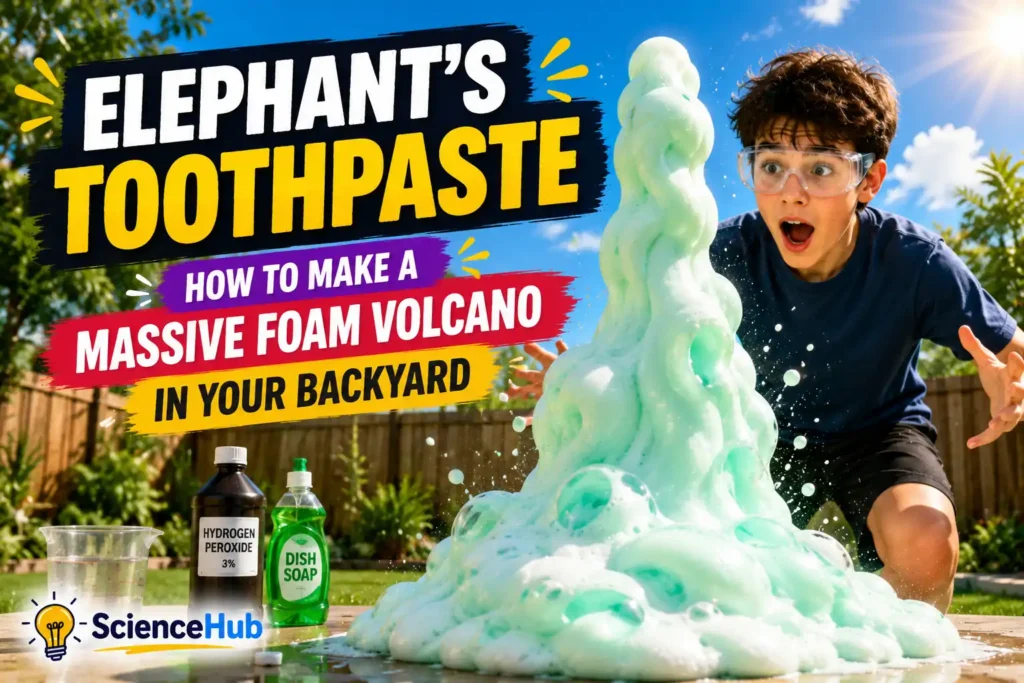
Okay, imagine this. You’ve got a normal plastic bottle sitting on the grass. You pour in some stuff that looks just like water, toss in a tiny bit of powder, and suddenly—BAM! A massive, thick, steaming pillar of foam shoots out of the bottle like a crazy geyser. It looks literally like toothpaste fit for a giant elephant. Making elephant’s toothpaste is an incredible science experiment.
I’m telling you, this is probably the most legendary backyard science experiment of all time. You’ve probably seen it on YouTube or TikTok, where people fill entire swimming pools with this stuff. But how does it actually work? It looks like magic, but it’s actually just a really aggressive, super-fast chemical breakup.
Let me break it down for you so you can understand exactly what’s happening under all those bubbles, and how you can safely pull this off without blowing up your kitchen.
The Secret Ingredient: Hydrogen Peroxide: Elephant’s Toothpaste
So, the main fuel for this whole crazy foam explosion is a liquid called hydrogen peroxide. You might actually have a small brown bottle of this hiding in your bathroom cabinet right now. Parents use a super weak version of it (like 3%) to clean out cuts and scrapes.
But for the really massive, mind-blowing Elephant’s Toothpaste eruptions, scientists use a way stronger version, like 30% or even 35% hydrogen peroxide. (Seriously, don’t mess with the strong stuff unless you have an adult who knows what they’re doing, because it can burn your skin!).
Now, what exactly is hydrogen peroxide?
Think about regular water. Water is H2O, right? That means it has two hydrogen parts and one oxygen part. They are best friends. They stick together perfectly.
Hydrogen peroxide is H2O2. It has an extra oxygen part jammed in there. Think of it like a bus that only has three seats, but four people squeezed in. That extra oxygen person is super uncomfortable and wants to get off the bus as fast as possible.
So, hydrogen peroxide is constantly trying to kick out that extra oxygen and just become normal water again. If you leave a bottle of it sitting on a table, it will slowly, over a few years, turn into water and oxygen gas. But that’s too slow. We want an explosion right now.
To learn more about how unstable chemicals break down naturally over time, you can check out the crazy cool articles over at Science Buddies.
The Catalyst: The Hype Man
To make the oxygen leave the bus instantly, we need a catalyst. A catalyst is basically like a hype man at a concert. It doesn’t actually join the band, but it makes the crowd go totally crazy and speeds up the whole show.
In this experiment, the catalyst we use is usually a powder called Potassium Iodide (or sometimes just regular baker’s yeast mixed with warm water if you’re doing the safe home version).
When you drop this catalyst into the hydrogen peroxide, it acts like a giant bouncer kicking that extra oxygen off the bus instantly. All the hydrogen peroxide molecules break apart at the exact same second. Suddenly, you have a massive amount of oxygen gas being created in the blink of an eye.
It’s like shaking up a soda bottle and taking off the cap, but a hundred times faster. If you want to dive deep into how catalysts speed up chemical reactions without getting used up themselves, the American Chemical Society has some awesome stuff to read.
Trapping the Gas: Bring on the Soap!
Okay, so now we have a huge burst of oxygen gas shooting out of the bottle. But if we just had gas, you wouldn’t see anything. It would just look like a quick puff of invisible wind. That’s boring.
To make the giant foam volcano, we need a trap. That trap is just regular liquid dish soap. Before we drop in the catalyst, we squirt a heavy amount of Dawn dish soap (and some food coloring to make it look cool) right into the hydrogen peroxide.
When the catalyst hits and creates all that oxygen gas, the gas tries to escape, but it gets physically trapped inside the sticky dish soap. The gas blows the soap up into millions and millions of tiny, thick bubbles in a fraction of a second. Because there are so many bubbles being created so fast, they have nowhere to go but straight up and out of the bottle.
If you want to feel like a real scientist while doing this, you’ve gotta grab some proper Anti-Fog Safety Goggles and maybe even a White Lab Coat. Seriously, safety first when you’re making stuff explode.
Also, when you do this, the foam gets really hot! This is called an exothermic reaction. “Exo” means outside, and “thermic” means heat. The chemicals are literally throwing heat outside into the air as they break apart.
To see some of the biggest Elephant’s Toothpaste world records ever attempted, people always check out the crazy videos from Guinness World Records.
Quick Eruption Summary
What you need:
– A plastic bottle (an empty 16oz water bottle works perfectly)
– 1/2 cup of Hydrogen Peroxide (3% for safety, or 6% beauty salon developer for a bigger kick)
– 1 big squirt of Liquid Dish Soap (Dawn works great)
– A few drops of Food Coloring (any color you want!)
– 1 packet of active dry yeast mixed with 3 tablespoons of warm water (This is your safe catalyst!)
Step-by-step guide:
1. Put your empty bottle inside a deep baking dish or do this outside on the grass so you don’t ruin the floor.
2. Carefully pour the hydrogen peroxide into the bottle.
3. Add your big squirt of dish soap and your food coloring. Swirl it around gently to mix it up.
4. In a separate little cup, mix your yeast and warm water. Stir it for about 30 seconds until it looks like melted ice cream.
5. Pour the yeast mixture into the bottle and step back instantly!
10 Elephant Brain Teasers
Ready to test your brain? See if you can figure out these riddles about the experiment we just talked about.
1. The Riddle: I look just like water, but I have an extra oxygen squeezed inside me waiting to break free. What am I?
The Answer: Hydrogen Peroxide.
2. The Riddle: I am the invisible stuff that escapes from the liquid, puffing up the soap into a giant mess. What am I?
The Answer: Oxygen gas.
3. The Riddle: I’m the hype man of the science world. I speed up the reaction without getting used up myself. What am I?
The Answer: A catalyst.
4. The Riddle: You use me to bake bread, but today I’m acting as a safe catalyst to blow up your science project. What am I?
The Answer: Yeast.
5. The Riddle: I am the sticky, gooey stuff you add to trap the invisible gas and turn it into visible foam. What am I?
The Answer: Dish soap.
6. The Riddle: This is the fancy science word for a reaction that gets super hot and throws heat outward. What is it?
The Answer: Exothermic.
7. The Riddle: I’m the chemical formula for water. Two parts hydrogen, one part oxygen. What am I?
The Answer: H2O.
8. The Riddle: I’m the safety gear you absolutely need to wear over your eyes when messing with strong chemicals. What am I?
The Answer: Goggles.
9. The Riddle: I’m the color you get if you mix red and yellow food coloring into your foam. What am I?
The Answer: Orange.
10. The Riddle: I’m the giant animal whose teeth this massive foam is supposedly meant to clean. What am I?
The Answer: An elephant.
The Wrap Up
Elephant’s Toothpaste is literally the coolest way to see chemistry in action. You aren’t just making a mess; you are actively watching molecular bonds tear apart at lightning speed. It’s like taking a million-year process and hitting fast forward.
If you want to read more about how heat and energy transfer during these kinds of crazy reactions, you should totally bookmark National Geographic Education. Now get outside, grab some yeast, and go make a mess! Making elephant’s toothpaste is an incredible science experiment.