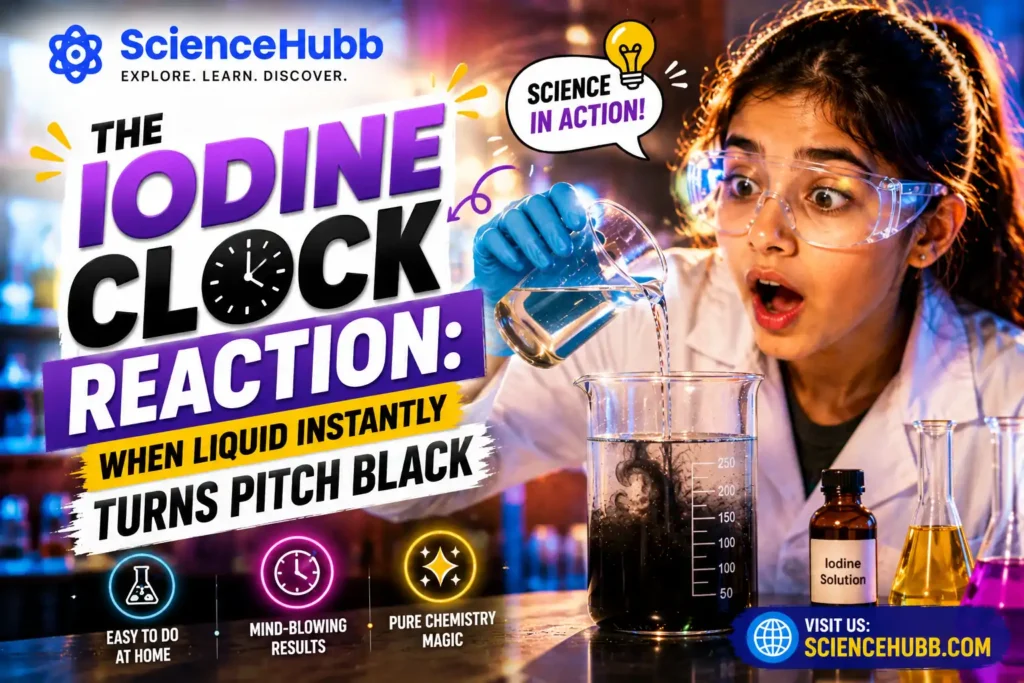
The Iodine Clock Reaction: When Liquid Instantly Turns Pitch Black
Table of Contents
Okay, listen. Most science experiments are kind of slow. You mix two things together, and then you sit there waiting forever while they slowly fizz, or maybe they slowly change color from blue to purple over like five minutes. It’s cool, but it isn’t exactly a jump-scare. This involves a fascinating chemical kinetics. Similar to experiments like elephant’s toothpaste. Similar to experiments like pharaohs serpent.
The Iodine Clock Reaction is totally different. It is literally the ultimate magic trick of chemistry.
Imagine you have two clear, totally see-through glasses of liquid. They look exactly like normal tap water. You pour one glass into the other. You stare at it. One second goes by. Two seconds go by. Five seconds go by. It still just looks like water.
Then, exactly on the tenth second—BAM! In less than a blink of an eye, the entire glass of clear liquid instantly turns absolutely pitch black. It doesn’t fade into black. It snaps to black like someone flipped a light switch.
How in the world does a clear liquid “know” exactly when to turn black? Let me break down the crazy hidden battle happening inside that cup.
Iodine Clock Reaction: The Invisible Tug-of-War
To understand this trick, you have to imagine an invisible game of tug-of-war happening inside the water. There are three main teams playing this game:
- Team Iodine: Iodine is an element that naturally looks dark brown or black.
- Team Vitamin C: Yep, the exact same Vitamin C you drink in orange juice!
- Team Starch: This is the stuff found in potatoes and bread.
Here is the secret rule of the game: If Team Iodine ever touches Team Starch, they instantly turn super dark, pitch black.
But Team Vitamin C doesn’t want that to happen. Vitamin C is like an incredibly fast bodyguard. Every single time Team Iodine tries to touch the Starch, Vitamin C jumps in the way and physically changes the Iodine back into a totally clear, invisible chemical.
So, when you first mix the liquids together, Iodine keeps trying to turn the water black, but Vitamin C keeps fighting it off at lightning speed. To your eyes, the water just looks completely clear and peaceful. You can read more about how Vitamin C acts as an antioxidant and fights off chemical changes over at the National Institutes of Health (NIH).
The Clock Runs Out!
But here is the catch. The Vitamin C bodyguards are getting exhausted. Every time they fight off the Iodine, a little bit of the Vitamin C gets permanently destroyed.
Because science is basically just math in real life, chemists can calculate exactly how many Vitamin C bodyguards are in the cup. They know exactly how long they can survive against the endless army of Iodine.
If you put a ton of Vitamin C in the cup, the water might stay clear for 60 seconds. If you only put a tiny bit of Vitamin C in, it might only last 5 seconds.
But eventually, the exact same thing always happens: The very last Vitamin C molecule gets destroyed. Suddenly, there are no more bodyguards left. In that exact fraction of a second, the entire army of Iodine crashes into the Starch all at once.
That is the “BAM!” moment. Without Vitamin C protecting the cup, the Iodine and Starch lock together and instantly dye the entire cup of water pitch black.
It is incredibly satisfying to watch. If you want to dive deeper into the insane math of how chemists time these chemical clocks down to the exact millisecond, check out the educational guides at the American Chemical Society (ACS).
Doing it at Home
You can actually buy professional kits to do this experiment, but you can also hack it together yourself using stuff from the pharmacy. You need liquid iodine (like the stuff used for cuts), crushed up Vitamin C tablets, hydrogen peroxide (to act as the Iodine army), and some liquid laundry starch.
It takes a lot of practice to get the measurements exactly right, so I highly recommend grabbing a cheap Glass Beaker Set with Measurements so you can track your liquids. And, because iodine stains literally everything it touches, you absolutely need a pair of Disposable Nitrile Gloves unless you want your hands to look like a tiger for a week.
If you want to see exactly how temperature affects this battle (spoiler: hot water makes the bodyguards die faster!), the physics geeks at Science Buddies have tons of variations you can try.
Quick Iodine Clock Summary
What you need:
– 1000mg Vitamin C tablets (crushed into powder)
– 2% Liquid Tincture of Iodine (from the pharmacy)
– 3% Hydrogen Peroxide
– Liquid laundry starch (or cornstarch mixed with warm water)
– Distilled water
Step-by-step guide:
1. Make Solution A: Crush a Vitamin C tablet into a fine powder and dissolve it in 2 ounces of warm distilled water.
2. Add 1 teaspoon of the liquid Iodine into Solution A. Notice how the Vitamin C instantly turns the brown iodine totally clear!
3. Make Solution B: In a brand new cup, mix 2 ounces of warm water, 3 tablespoons of Hydrogen Peroxide, and 1/2 teaspoon of liquid starch.
4. Now for the magic: Pour all of Solution A into Solution B.
5. Start counting. The Vitamin C bodyguards are fighting! Once they run out… BAM! The liquid turns pitch black instantly!
10 Pitch-Black Brain Teasers
Do you think your brain is faster than the chemical clock? Test yourself with these 10 riddles!
1. The Riddle: I am the dark element that desperately wants to turn the water pitch black. What am I?
The Answer: Iodine.
2. The Riddle: I am the fast-acting bodyguard from your orange juice that fights off the iodine to keep the water clear. What am I?
The Answer: Vitamin C.
3. The Riddle: I am the sticky stuff found in potatoes that iodine reacts with to create the dark black color. What am I?
The Answer: Starch.
4. The Riddle: I am the invisible chemical army that constantly pushes the iodine to attack the starch. What am I?
The Answer: Hydrogen Peroxide.
5. The Riddle: I am the completely clear liquid you start with to make sure no tap-water chemicals mess up the trick. What am I?
The Answer: Distilled water.
6. The Riddle: I am the protective gear you must wear so the iodine doesn’t permanently dye your skin orange. What am I?
The Answer: Gloves.
7. The Riddle: If you make the water incredibly hot, what happens to the timer before the water turns black?
The Answer: It speeds up (it happens faster).
8. The Riddle: I am the color of the liquid for the first 10 seconds of the experiment. What color am I?
The Answer: Clear (or transparent).
9. The Riddle: I am the color the liquid instantly snaps into when the Vitamin C completely runs out. What color am I?
The Answer: Black (or dark blue/black).
10. The Riddle: I am the piece of glass lab equipment with lines on the side that helps you measure the liquids perfectly. What am I?
The Answer: A beaker.
The Wrap Up
The Iodine Clock Reaction proves that just because water looks perfectly calm on the outside, doesn’t mean there isn’t a massive, violent chemical war happening on the inside.
It’s one of the few science experiments that actually feels like a magic trick. By doing math, you can control exactly when the color changes. If you want to learn more about how chemical reactions hide in plain sight, go read through the amazing archives at the Royal Society of Chemistry. Now grab some Vitamin C and start testing your own chemical clocks!
Cited Sources & Evidence
- National Institutes of Health (NIH)
- American Chemical Society (ACS)
- Science Buddies
- Royal Society of Chemistry
Summary: The Iodine Clock Reaction is truly one of the most incredible demonstrations of science.