Table of Contents
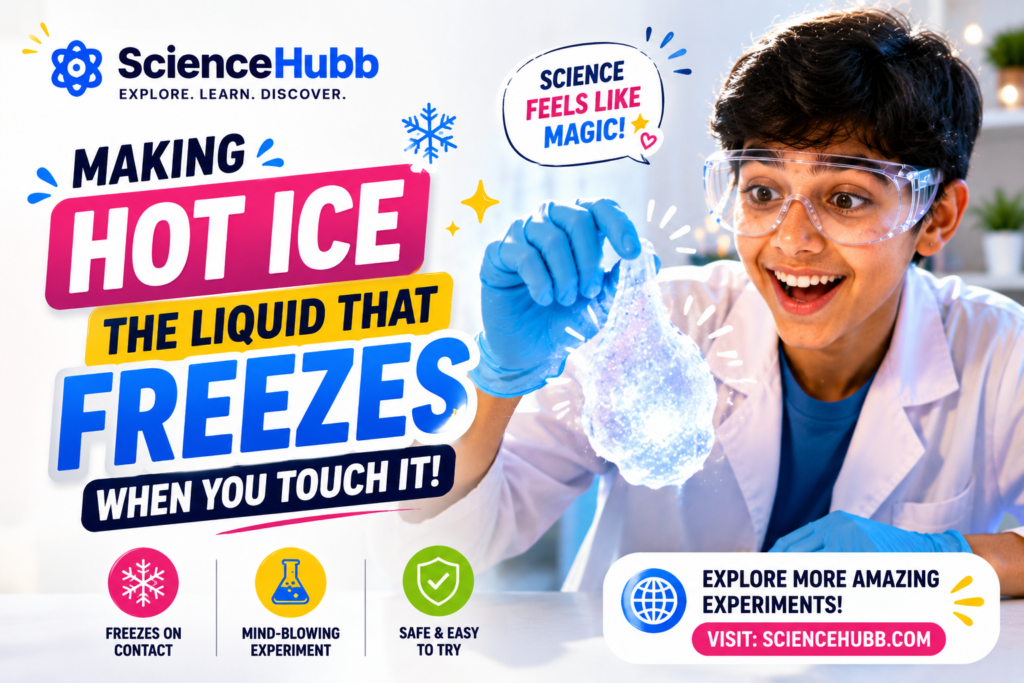
Okay, imagine you have a bottle of clear water sitting on a table. It looks totally normal. You unscrew the cap, stick your finger in the water, and instantly—in less than a second—the entire bottle of water freezes solid. It turns into a giant block of white ice right before your eyes.
But here is the craziest part: if you touch the outside of the bottle, it isn’t cold at all. In fact, it is burning hot!
This sounds completely impossible. Ice is supposed to be freezing cold, right? But this isn’t normal water. It is a crazy chemical called Sodium Acetate, and making “Hot Ice” is one of the most mind-bending experiments you can ever do. Let me break down how you can freeze something while actually making it hot.
The Secret of the Supercooled Liquid
To understand Hot Ice, you have to understand how normal water freezes. When you put water in the freezer, the temperature drops, and the water molecules slow down. Eventually, they get so cold they stop moving and lock together into solid ice crystals.
But Sodium Acetate is a total weirdo.
Sodium Acetate is a salt. (Not the salt you put on french fries, but a chemical salt). When you heat this salt up, it melts into a clear liquid. But here is the trick: if you let it cool down super, super carefully without bumping the glass or shaking it, it will drop way below its normal freezing temperature, but it will forget to turn into a solid!
This is called being “Supercooled.” The liquid is basically holding its breath. It desperately wants to freeze into a solid, but the atoms don’t know how to start the process. They need a trigger. They need a tiny bump to start the chain reaction.
If you want to read the seriously intense physics behind how supercooled liquids defy the laws of thermodynamics, you have to check out the American Physical Society (APS).
The Chain Reaction
So, you have a bottle of supercooled Sodium Acetate liquid. It is terrified. It is holding its breath.
When you stick your finger into the liquid, or drop a tiny crystal of salt into it, you are giving it the trigger it needs. The instant that tiny crystal touches the liquid, the atoms realize they are supposed to be solid.
They aggressively slam together, locking into crystal shapes. But it doesn’t stop there. One crystal locking together knocks into the next atom, causing that one to lock, which hits the next one, and the next one. It is like knocking over a million microscopic dominoes.
In a fraction of a second, the entire bottle of liquid turns into a solid block of white crystals that looks exactly like ice. You can actually pour the liquid slowly onto a plate, and it will freeze in mid-air, allowing you to build giant, solid crystal towers! You can read more about how crystals grow and form over at Science Buddies.
Why is it So Hot?
Okay, so it froze into a solid. Why is it giving off heat?
This all comes down to energy. When the Sodium Acetate was a liquid, the atoms were moving around freely. That movement requires energy.
When you trigger the freezing process, all of those atoms violently slam on the brakes and lock into a solid structure. Because they aren’t moving anymore, they don’t need all that extra energy. So, they throw the energy away!
How do chemicals throw away extra energy? They release it as pure heat. The bottle gets super warm to the touch. This is called an exothermic reaction. If you have ever bought those little plastic hand-warmers for winter camping that you snap to get hot—guess what? Those are filled with the exact same Hot Ice chemicals!
If you want to read more about how humans use exothermic reactions to survive in extreme winter weather, bookmark National Geographic Education.
Making It At Home
You can actually make Sodium Acetate yourself using normal stuff from your kitchen! All you need is baking soda and white vinegar. When you mix them together, they fizz up like a volcano. After the fizzing stops, you boil the leftover liquid on the stove until almost all the water is gone. What is left over is liquid Sodium Acetate!
Since you have to boil it on the stove for a while, it’s super smart to grab a highly accurate Digital Kitchen Thermometer to monitor the temperature. And remember, when making crystals, you want to store them in a perfectly clean, scratch-free Glass Beaker, because even a tiny speck of dust can accidentally trigger the freezing process early!
For a massive list of other awesome kitchen chemistry experiments, check out the archives at the National Science Foundation (NSF).
Quick Hot Ice Summary
What you need:
– 4 cups of white vinegar
– 4 tablespoons of baking soda
– A cooking pot and a stove
– A glass jar
Step-by-step guide:
1. Slowly add the baking soda into the vinegar in your pot. It will fizz wildly, so do it slowly!
2. Put the pot on the stove and boil the liquid on medium-low heat for about an hour. You want to boil away 90% of the water until you are left with a tiny bit of thick, clear liquid.
3. When a crust starts forming on the edge of the liquid, take it off the heat immediately.
4. Pour the clear liquid into a clean glass jar and put it in the fridge to cool down completely without shaking it.
5. Once it is cold, touch the surface of the liquid with your finger. BAM! Instant hot ice!
10 Freezing Brain Teasers
Let’s see if your brain is supercooled! Can you solve these 10 hot riddles?
1. The Riddle: I am the fancy science term for a liquid that drops below its freezing temperature but “forgets” to turn into a solid. What am I?
The Answer: Supercooled.
2. The Riddle: I am the weird chemical salt that looks exactly like frozen water when I turn solid. What am I?
The Answer: Sodium Acetate.
3. The Riddle: I am the everyday kitchen ingredient that you mix with baking soda to make this chemical yourself. What am I?
The Answer: Vinegar.
4. The Riddle: I am the invisible energy that gets violently thrown outward when the atoms slam on their brakes. What am I?
The Answer: Heat.
5. The Riddle: I am the fancy science word for any chemical reaction that gives off heat. What am I?
The Answer: Exothermic.
6. The Riddle: I am the tiny, microscopic piece of salt you drop into the liquid to trigger the crazy chain reaction. What am I?
The Answer: A crystal.
7. The Riddle: I am the popular winter camping gear you put in your pockets that uses this exact same chemical to keep you warm. What am I?
The Answer: A hand-warmer.
8. The Riddle: I am the tool you should use while boiling the liquid to make sure it doesn’t get too hot. What am I?
The Answer: A thermometer.
9. The Riddle: I am the state of matter that the liquid instantly turns into the second you touch it. What am I?
The Answer: A solid.
10. The Riddle: I am the classic toy that perfectly explains how the freezing atoms knock into each other in a massive chain reaction. What am I?
The Answer: Dominoes.
The Wrap Up
Hot Ice is the ultimate way to mess with your brain. It looks like ice, it acts like ice, but it feels like a hot cup of coffee.
By tricking the atoms into holding their breath as a supercooled liquid, you get to control exactly when and where they freeze into a solid. It is literally chemistry at your fingertips. If you want to learn more about how chemical salts are used in modern engineering, definitely read through the Royal Society of Chemistry. Now go grab some vinegar and start cooking some ice!
Cited Sources & Evidence
- American Physical Society (APS)
- Science Buddies
- National Geographic Education
- National Science Foundation (NSF)
- Royal Society of Chemistry