
10 Mind-Blowing Science Experiments Teenagers Can Do for Fun Learning
Have you ever wondered how to turn your kitchen into a secret laboratory? Forget boring textbooks and endless lectures—science is about explosion of ideas, jaw-dropping discoveries, and hands-on fun! If you are looking to unleash your inner mad scientist without burning the house down, you are in the exact right place.
Welcome to the ultimate guide of fun science experiments for teenagers. Whether you need a spectacular weekend project, a killer science fair idea, or just want to impress your friends with cool science tricks, these 10 effortless DIY science experiments will absolutely blow your mind. The best part? You probably already have all the materials lying around your house!
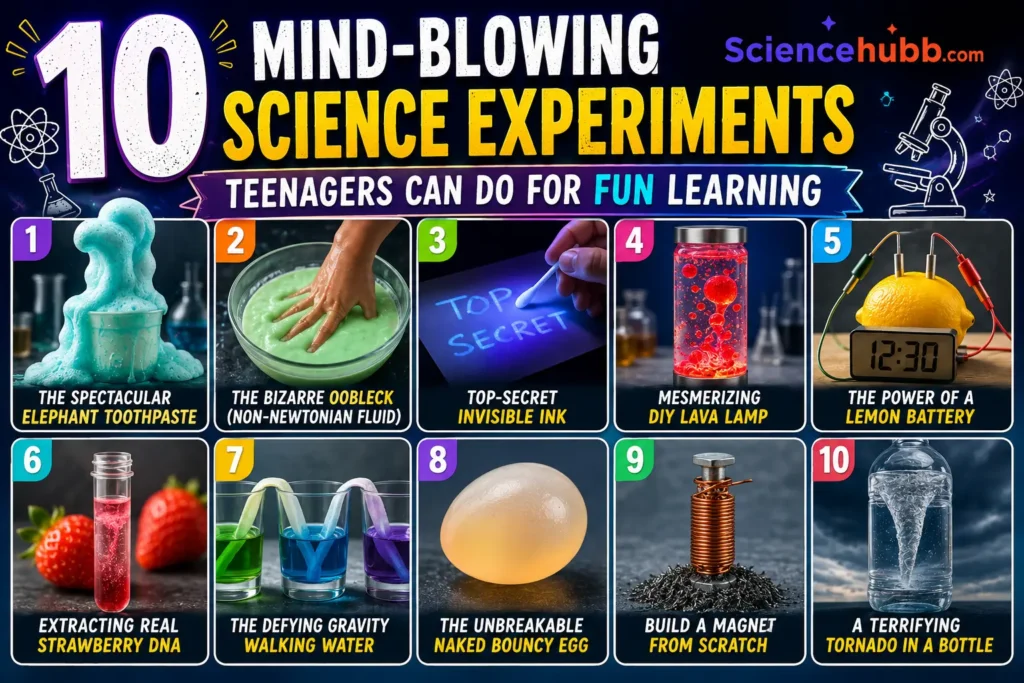
Are you ready to transform ordinary household items into extraordinary scientific phenomena? Let’s dive in!
Table of Contents
- 1. The Spectacular Elephant Toothpaste
- 2. The Bizarre Oobleck (Non-Newtonian Fluid)
- 3. Top-Secret Invisible Ink
- 4. Mesmerizing DIY Lava Lamp
- 5. The Power of a Lemon Battery
- 6. Extracting Real Strawberry DNA
- 7. The Defying Gravity Walking Water
- 8. The Unbreakable Naked Bouncy Egg
- 9. Build a Magnet from Scratch
- 10. A Terrifying Tornado in a Bottle
1. The Spectacular Elephant Toothpaste
Want to create a massive, erupting volcano of foam that looks like it belongs in a sci-fi movie? This is the undisputed king of cool science tricks!
What You Need: Empty plastic bottle, 1/2 cup of 3% hydrogen peroxide, a squirt of dish soap, food coloring, 1 tablespoon of dry yeast, and 3 tablespoons of warm water.
The Steps: Mix the hydrogen peroxide, dish soap, and a few drops of food coloring in the bottle. In a separate cup, mix the yeast and warm water for 30 seconds. Now, pour the yeast mix into the bottle and step back!
The Science: The yeast acts as a catalyst, rapidly breaking down the hydrogen peroxide into water and oxygen gas. The dish soap traps the gas, creating a massive, epic foam eruption!
2. The Bizarre Oobleck (Non-Newtonian Fluid)
Is it a solid? Is it a liquid? This mind-bending substance will literally trick your brain and challenge the laws of physics!
What You Need: 2 cups of cornstarch, 1 cup of water, food coloring (optional).
The Steps: Simply mix the cornstarch and water in a large bowl. Punch it hard—it feels like a brick! Now, rest your hand on it slowly—it sinks right in like quicksand!
The Science: Oobleck is a non-Newtonian fluid. When you apply force, the particles lock together, acting like a solid. When you move slowly, it flows freely like a liquid.
3. Top-Secret Invisible Ink
Channel your inner secret agent and send hidden messages that only your friends can reveal. This trick never gets old!
What You Need: Half a lemon, water, a cotton swab, white paper, and a heat source (like a lamp or hairdryer).
The Steps: Squeeze the lemon juice into a bowl and mix with a few drops of water. Dip the cotton swab in the juice and write your secret message on the paper. Wait for it to dry completely. To reveal it, gently heat the paper using the lamp or hairdryer.
The Science: Lemon juice is mildly acidic and weakens the paper. When heated, the carbon compounds in the juice oxidize and turn brown faster than the paper around it!
4. Mesmerizing DIY Lava Lamp
Create a stunning, glowing, bubbling masterpiece for your bedroom. It’s absolutely hypnotic and ridiculously easy to make.
What You Need: A clear bottle or glass jar, vegetable oil, water, food coloring, and an Alka-Seltzer tablet.
The Steps: Fill the bottle 3/4 full with vegetable oil, and the rest with water. Add 10 drops of food coloring (it will sink through the oil and mix with the water). Drop in a broken Alka-Seltzer tablet and watch the magic unfold!
The Science: Oil and water don’t mix due to different densities. The tablet reacts with the water to create carbon dioxide gas, which attaches to the colored water blobs, carrying them to the top. When the gas escapes, the blobs sink back down!
5. The Power of a Lemon Battery
Can you really generate electricity from a piece of fruit? Absolutely! Prepare to be amazed by this classic STEM activity for high schoolers.
What You Need: 2-3 lemons, copper coins (like pennies), galvanized nails (zinc-coated), copper wire, and a small LED light.
The Steps: Roll the lemons to get the juices flowing. Insert one penny and one nail into each lemon. Connect them in a series using the copper wire (nail to penny, nail to penny). Finally, connect the two ends to the LED light pins!
The Science: The lemon juice acts as an electrolyte. A chemical reaction occurs between the zinc and the copper, pushing electrons through the wire and powering the lightbulb!
6. Extracting Real Strawberry DNA
Ever wanted to literally see the building blocks of life? You can extract actual DNA from a strawberry in your kitchen. This is as cutting-edge as teenager science activities get!
What You Need: 2 fresh strawberries, a ziplock bag, 2 teaspoons of dish soap, 1 teaspoon of salt, 1/2 cup of water, a coffee filter, and cold rubbing alcohol (keep it in the freezer beforehand).
The Steps: Mash the strawberries inside the ziplock bag. Mix the soap, salt, and water, then add it to the bag and mash again. Filter the liquid through the coffee filter into a clear glass. Slowly pour the freezing cold rubbing alcohol down the side of the glass.
The Science: The soap breaks down the cell walls, the salt clumps the DNA strands together, and the cold alcohol causes the DNA to precipitate out of the solution, forming a white, cloudy, stringy substance you can actually pick up!
7. The Defying Gravity Walking Water
Watch in awe as colorful water completely defies gravity and seemingly walks right over a bridge!
What You Need: 3 clear glasses, water, food coloring (red and blue), and paper towels.
The Steps: Fill the outer two glasses with water and add a different food coloring to each. Leave the middle glass completely empty. Fold two paper towels into strips and place one end in a full glass and the other in the empty glass. Wait a few hours.
The Science: Through capillary action, the water travels up the tiny gaps in the paper towel fibers, defying gravity to eventually fill the empty glass in the middle and mix the colors!
8. The Unbreakable Naked Bouncy Egg
Transform a fragile, ordinary raw egg into a bouncy, squishy ball right before your eyes.
What You Need: One raw egg, white vinegar, and a tall glass.
The Steps: Place the raw egg carefully into the glass and cover it completely with white vinegar. Leave it for 48 hours. Carefully wash it under gentle water and rub off any remaining shell. Now, try bouncing it gently on a plate!
The Science: The acetic acid in the vinegar completely dissolves the calcium carbonate shell. The egg is held together only by a thin, semi-permeable membrane, making it rubbery and bouncy!
9. Build a Magnet from Scratch
Did you know you can turn an ordinary nail into a powerful magnet using just a battery? Welcome to electromagnetism!
What You Need: A large iron nail, insulated copper wire, a D-cell battery, and some small paperclips.
The Steps: Tightly wrap the copper wire around the iron nail at least 50 times (leave the ends loose). Strip a little insulation off the ends of the wire and tape them to the positive and negative ends of the battery. Now, touch the nail to the paperclips!
The Science: When electrical current flows through the coiled wire, it generates a strong magnetic field around the iron nail, instantly turning it into a working electromagnet!
10. A Terrifying Tornado in a Bottle
Trap the devastating power of a real-life tornado right in the palm of your hands!
What You Need: Two 2-liter plastic bottles, water, duct tape, and a metal washer (or a plastic tornado connector tube).
The Steps: Fill one bottle about 3/4 full of water. Place the washer on top, flip the empty bottle upside down, and tape them together tightly so no water leaks. Turn the bottles over so the water is on top, give it a hard circular swirl, and watch the vortex form!
The Science: The circular motion creates a centripetal force that forms a vortex. The hole in the middle allows the air to rush up while the water rushes down, simulating the exact mechanics of a real tornado!
Ready to Start Experimenting?
There you have it—10 phenomenal, simple, and jaw-dropping DIY science experiments that prove science isn’t just for dusty old labs! By testing these out, you aren’t just having fun; you are literally bending physics, observing chemistry in real-time, and witnessing the sheer beauty of biology.
Which experiment are you going to tackle first? Grab your materials, unleash your curiosity, and remember: every great scientist started by asking “What if?” Now go out there and create some spectacular science!
1 Comment